
 The Boy Who Invented The Bubble Gun
by Paul Gallico
Dell 0719
Copyright 1974
Nine and a half year-old Julian West is an innovated kid. He came up with his own little invention, a toy gun that shoots bubbles, and he is pretty excited about it. Shunned by his father, Julian sneaks out one night and with $150, he hops onto a Greyhound bus going to Washington to get a patent for his “bubble gun.” Well, the adventure begins and along the way we see it unfold through the eyes of the young boy.
The novel is subtitled An Odyssey of Innocence, and Paul Gallico beautifully captures that inevitable moment in life, when a young boy realizes that childhood is over and discovers what the world is really like. During Julian’s passage, he touches the lives of an odd assortment of characters. He meets up with two love-struck teenagers, a cat-and–mouse drama between the KGB and CIA, an immigrant musician looking forward to a new life in America, and there is even an unstable killer who attempts to hijack the bus. But its the bond between Julian and a disillusioned Vietnam veteran named Frank Marshall, that brings the reality of the existence of the unfair laws of human nature to him. Marshall takes to the kid, protecting and befriending him. Julian looks up to Marshall, who comes to symbolize many things in a world that can be both awe-inspiring and dangerous. And it is because of the trip and the time he spends with Marshall, that allows in the end, Julian’s relationship with his father to develop.
This is the second time that I read “The Boy Who Invented The Bubble Gun,” the first time was when it came out in 1974. The story of a nine year-old traveling alone across the country and some of the interactions between the characters, may be a bit unbelievable today. But I enjoyed it in 1974, and again in 2009. Paul Gallico was a remarkable writer. (If you ever read “The Snow Goose,” you'll know what I mean) It doesn’t matter that the novel was written 35 years ago, Gallico’s writing touches your heart and the maturing of Julian West will be long remembered.
“The Boy Who Invented The Bubble Gun” is a compelling story that takes us on a journey that is both heartwarming and inspiring.
Monday, May 30, 2011
The Boy Who Invented The Bubble Gun by Paul Gallico


Saturday, May 14, 2011
Flashpoint by George La Fountaine
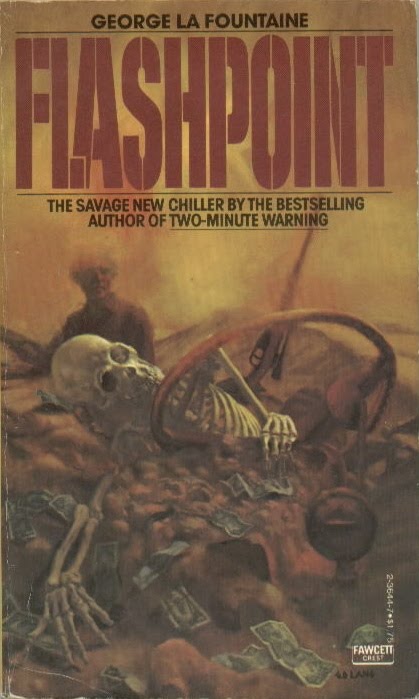 FlashPoint by George La Fountaine
Fawcett 2-3644-7
Copyright 1976
"But who in the hell can we trust to ask about it? We can't just walk into a bank and ask if this is counterfeit; they might be looking for numbers or something."
Ernie Wheeler and Bob Logan are best friends. They do everything together - eat, booze it up, lure the ladies to their bachelor pad-everything. They also work together, they are 1970s Border Patrol officers along the dry South Texas barren lands. Things are changing for them. The computer age is stepping in and they see the threat of their free-roaming job being replaced with one sitting behind a computer desk. They talk of chucking it all away and live high, but you need cash in the bank for that and they don't have any. Opportunity knocks one day when Logan discovers an old half buried jeep in a desert wash. Inside the jeep is a skeleton and $850,000 . The bills are dated back to the early 60s and since there is a rifle and other odd items in the jeep, Logan and Wheeler decide to secretly investigate into why it was there and who the bones belong to in the jeep. They later learn there is much more to this mystery than they ever thought. Deadly more....
Flashpoint is one of those fast paced thrillers that filled the book racks in the mid 70s. I had a hunger for them back then and this one slipped under my radar. I'm glad I caught up to the paperback. It contains all the ingredients for a violent, mysterious novel and as I was racing through it, I was always wondering on how it was going to end. It has a climatic finish which if you don't pay attention to the little clues that George La Fountaine provides throughout the novel, you might be very surprised. Logan and Wheeler are two well developed characters. They come off as semi-tough guys and show sympathy for the flight of the illegal immigrants. The only problem I had with them was they were a little too close of friends. A lot of interesting government intervention makes the mystery deepen. As the cover states, George La Fountaine wrote Two Minute Warning which was a huge success for him. For me, Flashpoint stands up right along side it.
Saturday, October 16, 2010
Eight Million Ways To Die by Lawrence Block
 Eight Million Ways To Die by Lawrence Block
Arbor House Publishing
Hardcover edition, Copyright 1982
My life was a ice floe that had broken up at sea, with different chucks floating off in different directions. Nothing was ever going to come together, in this case or out of it. Everything was senseless, pointless, and hopeless.
This is the fifth novel in the Matthew Scudder series and it's been hailed as the one that propelled the character and the series into wide notability. But if you read the previous novel, A Stab in the Dark, you could see it started there. In Eight Million Ways to Die, the "unlicensed" NYC PI does really breakout and Lawrence Block gives us one of the best detective mystery novels that was published in the 1980s.
As he sits in Jimmy Armstrong's, his favorite watering hole, ex-New York cop Matthew Scudder doesn't take every case that walks through the door. He picks and chooses, and it has to "feel right." The money feels right when call-girl Kim Dakkinen hires Scudder to talk to her pimp about freeing her from his stable. After finally locating the elusive pimp that goes by the street name Chance, Scudder finds that this case is easy money because Chance has no problem letting Kim go. For him, there are girls getting off the bus every day in NYC that he can hustle. But when Kim Dakkinen is found brutally slaughtered in a hotel room the next day, all fingers point to Chance. Though still a suspect, he has an air-tight alibi and with the police lose interest in solving a prostitute's death, Chance wants Scudder to investigate into her murder.
There is really two stories (or three) going on in Eight Million Ways to Die. One of course is the mystery surrounding why Kim Dakkinen was butchered and who did it. Block actually gives us all the clues, but we miss them because we are absorbed by the second storyline in the novel, and that is Matthew Scudder's battle with alcoholism. On the wagon and falling off it, the day to day punishment to stay sober bleeds through the pages towards the reader. It's remarkably well done. Down church basements to sit in the back at AA meetings and never participating, Scudder is really alone fighting off this demon that has plagued him. It's powerfully written and I found it more interesting than the fine whodunit plot in the novel. Another thing Block excelled on was creating a NYC where the streets are gray, dismal and violent. He throws this at us by having Scudder reading from the papers or talking with a befriended cop about the amount of relentless murders that are occurring in the City. And this bleak atmosphere goes directly in parallel with the inner conflicts tormenting Matthew Scudder's life. Scudder finds himself not immune to this violence also. There is an outstanding scene where he is pushed into a dark alley, mugged, and has to battle with his attacker. After all he is one of the eight million living in New York City.
All I wanted was an excuse to walk through the door of that bucket of blood and put my foot upon the brass rail. I closed my eyes and tried to picture the place, and in an instant I was recalling everything about it, the smells of the booze and stale beer and urine, that dank tavern smell that welcomes you home.
I wasn't sure is I was rooting for Matthew Scudder in this one or feeling sorry for him. I do know that when I first read this novel it played with my emotions. I never read anything like this in a PI novel before. The novel is filled with well developed secondary characters, the best being the pimp Chance and his small harem of prostitutes. Add Matthew Scudder and great storytelling, and Eight Million Ways to Die becomes a monumental PI novel. It is that.
If you are going to read just one Matthew Scudder novel, this is the one you want to read. But beware, I guarantee after this one you will want to read more.
Sunday, October 10, 2010
Mackenna's Gold by Will Henry
 Mackenna's Gold by Will Henry
Copyright 1963
For comforting an old Apache during his last dying hours, prospector Glen Mackenna is bestowed with the secret location of the Lost Canyon of Gold. Called Sno-ta-hay by the Apache, the canyon is a sacred place where mass amounts of gold are protected by ancient spirits. After memorizing the map even though he believes this is just a fable, Mackenna is then captured by the ugly renegade half-breed Pelon Lopez and his band of outlaw Indians. Pelon wants Mackenna to lead them to Sno-ta-hay and to persuade him to do so he holds a white girl hostage. Well, the adventure begins and along the way there are plenty of killings, a cavalry of Buffalo Soldiers hunting them down, forced alliances with nasty villains, and the truth about the legend of the Lost Adams Diggings at the Canyon of Gold.
What might lie ahead for his companions, he could not begin to imagine. What lay ahead for himself, he did not dare to think about. For the moment, only one thing was to be regarded as absolute certain: in such a company of human animals as that with whom he now loped through the desert night, death was no farther away than the nearest member of the pack.
Written by Will Henry (Henry Wilson Allen) in 1963, Mackenna’s Gold packs quite a bit of action in an evenly-paced Western novel. Though not a masterpiece, the plot that is spun around the quest for the gold is very good. In reality, there is a legend of the Lost Adams Diggings (a man named Adams boasted of finding the gold-filled canyon in 1864) and even today fanatics search for this legendary lost canyon. The Adams tale is the driving force in Mackenna’s Gold. And when you mix in the ragtag pursuit for the gold, Will Henry spins a decent Western story here. But I did have a few problems with the novel, most of them revolve around the characters. Mackenna comes off like a cream puff, he toughens up at the end but his image is cast early in the story. The hostage white girl is never really developed by Will Henry and only seems to be in the story as an excuse to force Mackenna to show the renegades the way. And Pelon is a total enigma. At times he is a vile, violent, ignorant killer and then later he acts almost Shakespearean as he rants to Mackenna about compassion and fate. It’s the pure-blood Native American characters in the story that captivate the reader. Pelon’s mother and sister, who are along on the quest, are the most intriguing of the group. Henry details their past and they play important roles in the outcome of the story. Another Indian called Hachita, who shows compassion towards Mackenna, extends to the reader a sense of the lost wonders of the American Indian way of life. Like a heart that has been touched by the sound of the water and the songbirds in the canyons, Hachita portrays a stature of honesty and morality when compared to all the other characters in the novel. I really liked the Hachita and Henry did a good job with the character.
Overall, I liked “Mackenna’s Gold.” Will Henry always has something going on in the story. The book has an underlying theme about the craze for gold and the consequences of tampering with sacred legend. And the history surrounding the Lost Adams Diggings is so damn interesting, it keeps the reader glued to the pages.
Not perfect, but it still is a good Western adventure.
Saturday, October 2, 2010
The Body Lovers by Mickey Spillane
 The Body Lovers by Mickey Spillane
Signet P3221
Copyright 1967
Spillane's The Body Lovers was written when Mike Hammer came out for round two. Round one being the six explosive Hammer novels from 1947-1952. In the 60s, the toughest fictional PI reappeared in five more novels. Some say they fall a step behind when compared to the first ones, but to me The Girl Hunters (1962) and The Twisted Thing (1966) didn't miss a beat. As for The Body Lovers, I will agree that it's not even near being one of top novels that feature Mike Hammer. But it still is a Mickey Spillane novel, and it still has the violently vindictive Mike Hammer reeling out his own ways of justice, and it still is entertaining as hell.
But it wasn't her he was seeing. It was me he was watching. I was one of his own kind. I couldn't be faked out and wasn't leashed by the proprieties of society. I could lash out and kill as fast as he could and of all the people in the room, I was the potential threat. I knew what he felt because I felt the same way myself.
Bang page one, Hammer stumbles upon a body of a beautiful girl that was whipped to death. From his cop buddy Capt. Pat Chambers, he finds out that other girls have been found tortured and killed. The only lead is that all were found wearing exotic negligee. Mike stays out of this one, even though most of the press and the public believes otherwise. But not for long, because a crook that Hammer sent to the slammer hears about the murders and hires Mike to locate his missing sister. The sister knew the dead girls and might be next. Quickly Hammer is setup for a hit, botched of course with him blasting the hood to kingdom come. The trail leads to the high fashion world and shady UN delegates. And when Velda, Hammer's full-time secretary and part-time associate, gets caught in the action and Mike discovers her missing, not only does he pulled back his snarly grin, the hammer on the .45 gets cocked and he is ready to release his rage.
A little less hard than you'll find in other Hammer novels. But when I comes, it comes. The best by far is when Hammer is looking for a pimp named Lorenzo Jones. He locates Roberta, one of Jones' whores. Roberta agrees to tell him where Jones is hiding but on one condition, Hammer must take her along to watch him kick the crap out the pimp. It's Spillane at his best. In The Body Lovers, Hammer comes off a bit older. He even realizes it. At one point he talks about dissection thinking and missed clues in this head, "Little voices, I thought. They were saying something, but were too far away to be heard. It wasn't like the old days any more. I could think faster then." But when he's ready to cut down the evil that has spread throughout the city, our revenge seeking white knight doesn't fail the reader.
This one has all that makes Mike Hammer novels a fun read. Including Hammer's (and Spillane's) views about commies, diplomatic immunity, bleeding-heart liberals creating loopholes in the justice system-they are all here. The reader is never disappointed. You can't go wrong picking up a Mickey Spillane novel. He was an American icon and created one of the most memorable private detectives in fiction.
Every now and then you have to get your Mike Hammer fix.
Friday, September 24, 2010
The Deep End by Owen Dudley
 The Deep End by Owen Dudley
ACE D-195
Copyright 1956
But you don't shoot cops. That's the end, if you do. The real deep end.
Pete Summer lost his memory from a plane crash over Mexican waters. As his memory returns, he decides to hide out in a quiet Mexican town for a year. And for good reason. Back home in California they believe he killed the man that he was flying to South America on a mineral deal. Everyone thinks Pete Summer is dead until a visitor arrives bringing back bad memories. He learns that his gorgeous wife is now married to an ex-gangster. Not only does Pete miss his wife, he is totally obsessed with her. So he decides to head back home to reclaim his wife. And that may not be such a great idea.
His face hardened. "Let's not kid ourself. You've got a beautiful pan hooked onto a terrific body. But there's nothing behind the face. You just do what I tell you and keep your mouth shut."
Owen Dudley is just one pseudonym that author Dudley Dean McGaughey used. He wrote plenty of novels and short stories, and Westerns fill the bulk of his work. But he did churn out crime mysteries and even some movie novelizations. (my favorite is End of the World for the 1962 Ray Milland film Panic in Year Zero!) He's a darn good storyteller and his early Gold Medal Westerns are some the best that they published. As for The Deep End, it's not the best Dudley Dean book that I've read, but it has a interesting little plot going on.
Pete Summers is a veteran of two wars,WWII and Korea, and that helped mold him into a tough hombre. But the odds are stacked against him from the start. Once word gets out that he is alive and in town, just about everyone is out to get him. Pete's brother-in-law has positioned himself to benefit having Pete presumed dead. Pete's arrival has jeopardize that. His wife's new husband has three thugs hanging around, ready to get their hands on Pete. And then he discovers that the man who bought his old ranch has been bedding his wife for years. After being left for dead in an old sewer hole, Pete really sets out to clear his name from the murder charge and even it up against those who wronged him.
It's a story that has been told before, it even includes that young girl character who had a crush on Pete growing up and is willing to help him through his quest. I liked the Mexican tie-in and having an ex-gangster as his wife's new husband. There a bit about the old guy having trouble satisfying his wife and resorting to hormone ejections. (No Viagra in the 1950s fellas!) It's a hardboiled read and it has plenty of action, but there are really no surprises in the end. But that doesn't make it one that should be written off. Even though the cops and others are gunning for Pete, it really isn't a "man on the run" novel. Pete seems free to roam about as he uncovers secrets and lies from the past, many involving his wife who was everything to him. The novel zips along at a fast clip, and it has to because these ACE paperback novels rarely get beyond 150 pages. Overall a fairly decent job. What is real good about this ACE Double paperback is the flip novel, The Quaking Widow by Robert Colby. Colby never got the fame and recognition that he deserved. Besides his outstanding Gold Medal paperbacks and his fine short stories, he had four novels published by ACE. I've read them all and The Quaking Widow is the best of the four.
Saturday, September 11, 2010
Day Never Came by Steve Fisher
 Day Never Came by Steve Fisher
Copyright 1938
Short Story in Ellery Queen's Mystery Magazine, Oct. 1953
Steve Fisher packs a lot in the pages of this short psychological thriller. Day Never Came is a bleak and dark story of a psychotic killer who gets a little too clever for his own good.
Set in prewar Shanghai as the Japanese are bombing the city, a isolated American Marine station waits for orders with a handful of jailed service members awaiting court-martial. Most involve petty stuff, but the Navy prisoner called Clark is in for espionage and as for moral principles, he has none. There is a witness out in the city and his only hope is to get to her before the trial. Clark plans and executes an escape which involves secretly murdering a guard. Dodging bombs he makes his way to the girl's apartment. The kicker is that the girl loves him, but that's a one way street for Clark and he ends up strangling her to keep her from testifying. Without being seen, Clark quitely sneaks back into the Marine brig and thinks he devised a solid alibi. Of course you can be a little too clever, and Clark surely is ... as we waits in his cell.
Readers of Steve Fisher's work know that he was a highly influential author in his day. Pulp, noir, and lives lost in the seedy underworld - his novels and stories are filled with a gritty, raw, (and yes, a romantic) edge on them. Day Never Came has all those. Unseen love, which Clark doesn't realize until it's too late. Madness, as he kills without remorse to save his neck. And pain, sadness, and a lost chance-as he sits in his locked cell at the end. For a short story it's very atmospheric and "the nasty's" what go around in Clark's head are oddly appealing. For me this short story came up as the best of the bunch in this fine 1953 edition of EQMM.
But that is not to say that the others weren't very good. Fredric Brown's 4 pager titled, Cry Silence is a masterfully written tale that questions, "was it murder or was it not." Which lines in parallel to the old question, "If a tree falls in the forest and no one is there to hear it, does it make a sound?" Another enjoyable yarn is the retired cop story Before The Act. Thomas Walsh wrote solid cop mystery novels (some involve rogue cops) and after reading The Night Watch and Nightmare in Manhattan, I realized I'd stumbled on lost treasures. I enjoy his storytelling and when I come across an anthology with a short story of his in it, I'll but it. And that was the reason I bought this EQMM years ago.
Here are the stories in this October 1953 edition:
High Court by Thomas Kyd
The Stroke Of Thirteen by Lillian de la Torre
Before The Act by Thomas Walsh
Laugh It Off by Charlotte Armstrong
Day Never Came by Steve Fisher
Cry Silence by Fredric Brown
A Wish For A Cigar by Will Scott
Ms. In The Safe by Frank Swinnerton
Night Of The Execution by Faith Baldwin
Helpless Victim by C.G. Lumbard
The World Series Murder by Rex Stout

