
 The Khufra Run by James Graham (Jack Higgins)
MacMillan Hardcover
Copyright 1972
Published in 1972, "The Khufra Run" is another adrenalin-filled adventure that was written under the author's pseudonym of James Graham. In his early writing days, Jack Higgins took the reader to different locations and in this one we start in Ibiza, Spain. Ex-'Nam pilot Jack Nelson runs a charter floatplane service there and he has been known to take a job or two on the illegal side when cash is low. Along with Harry Turk, an American ex-Marine that Nelson befriended when both were captured by the Viet Cong, they stumble on an opportunity to retrieve a loot of sunken treasure in the Khufra Marshes. But of course it won't be easy to accomplish. An abstruse nun, who Nelson saves from being raped, only knows the exact location of the treasure. A violent group is after her for the secret and her life is constantly in jeopardy. As the nun gains knowledge that Nelson and Turk have commando skills that can even the score against a formidable enemy, she allows both men to protect her and help recover the treasure for a share. As in most Higgins novels the action starts quick and never lets up. Nelson's plane is destroyed, there are more attempted attacks to stop them, and with a small cache of weapons the race is on to the Khufra Marshes.
Higgins is a master at narration. The trek that Nelson, Turk and the nun take to the marshes is an intense ride for the reader, all captured in a group of explosive chapters. Throw in an aging Hollywood starlet who may have a stake in the outcome, illegal drugs, bad weather in a hostile environment, explosions and constant dodging of automatic gunfire- and "The Khufra Run" becomes one of the best novels that I have read by Jack Higgins.
Jack Higgins wrote four novels under the name of James Graham. All take you on a deadly adventure that is packed with action between pages of a darn good plotted story:
A Game for Heroes (1970)
The Wrath of God (1971)
The Khufra Run (1972)
The Run to Morning (1974)
Saturday, July 16, 2011
The Khufra Run by James Graham (Jack Higgins)


Saturday, June 4, 2011
Luke Malone - Manhunter
 In 1975, Atlas Comics - a little known comic book publishing company, released a three issue run featuring a rugged San Francisco private eye named Luke Malone. Luke Malone-Manhunter was the back story in the comic book series called Police Action featuring Lomax NYPD. Created and drawn by artist Mike Ploog, Malone is an ex-city detective who hits the bottle after his wife is killed in a botched bank robbery in which he was called on. Thrown off the force, Malone can be found crawling through dirty gin-joints and in the street gutters of Frisco. It is there where he mopes around with a “I don’t care” attitude. He is content being a violent rummy until a friend tells him that the mastermind of the bank robbery is still on the loose and convinces Malone to try his hand at being a P.I. Now he is on the prowl and hits the streets to settle the score. Tough-talk dialogue and fine artwork make Luke Malone-Manhunter a surprisingly good hard-boiled comic
 I have the first two of the 3 issue run of the series. The first one is called "Requiem for a Champ" (February 1975) and has Malone solving the murder of a skid-row bum who was once a lightweight boxer. The P.I. starts interfering in police business which takes him to an old burlesque queen, mob men, and on the receiving end of thumps on the head. The second issue is "Whatever Happened to Luke Malone?" (April 1975) and this is an origin story about how Malone came to be a P.I., which I briefly outlined above. These are quick scripted stories, containing plenty of creeps as bad guys and violent 1970s action that fulls up every frame.
If you like detective stories that are told and illustrated in comic books and graphic novels, you'll find Luke Malone-Manhunter to be up your alley. It is unfortunate that the comic book character had a short run, because the plots are tightly packaged and the Luke has a hard-edged vigilante soul inside him. When Luke Malone steps in to play ball, he turns it into a mean game.
Monday, May 30, 2011
The Boy Who Invented The Bubble Gun by Paul Gallico
 The Boy Who Invented The Bubble Gun
by Paul Gallico
Dell 0719
Copyright 1974
Nine and a half year-old Julian West is an innovated kid. He came up with his own little invention, a toy gun that shoots bubbles, and he is pretty excited about it. Shunned by his father, Julian sneaks out one night and with $150, he hops onto a Greyhound bus going to Washington to get a patent for his “bubble gun.” Well, the adventure begins and along the way we see it unfold through the eyes of the young boy.
The novel is subtitled An Odyssey of Innocence, and Paul Gallico beautifully captures that inevitable moment in life, when a young boy realizes that childhood is over and discovers what the world is really like. During Julian’s passage, he touches the lives of an odd assortment of characters. He meets up with two love-struck teenagers, a cat-and–mouse drama between the KGB and CIA, an immigrant musician looking forward to a new life in America, and there is even an unstable killer who attempts to hijack the bus. But its the bond between Julian and a disillusioned Vietnam veteran named Frank Marshall, that brings the reality of the existence of the unfair laws of human nature to him. Marshall takes to the kid, protecting and befriending him. Julian looks up to Marshall, who comes to symbolize many things in a world that can be both awe-inspiring and dangerous. And it is because of the trip and the time he spends with Marshall, that allows in the end, Julian’s relationship with his father to develop.
This is the second time that I read “The Boy Who Invented The Bubble Gun,” the first time was when it came out in 1974. The story of a nine year-old traveling alone across the country and some of the interactions between the characters, may be a bit unbelievable today. But I enjoyed it in 1974, and again in 2009. Paul Gallico was a remarkable writer. (If you ever read “The Snow Goose,” you'll know what I mean) It doesn’t matter that the novel was written 35 years ago, Gallico’s writing touches your heart and the maturing of Julian West will be long remembered.
“The Boy Who Invented The Bubble Gun” is a compelling story that takes us on a journey that is both heartwarming and inspiring.
Saturday, May 14, 2011
Flashpoint by George La Fountaine
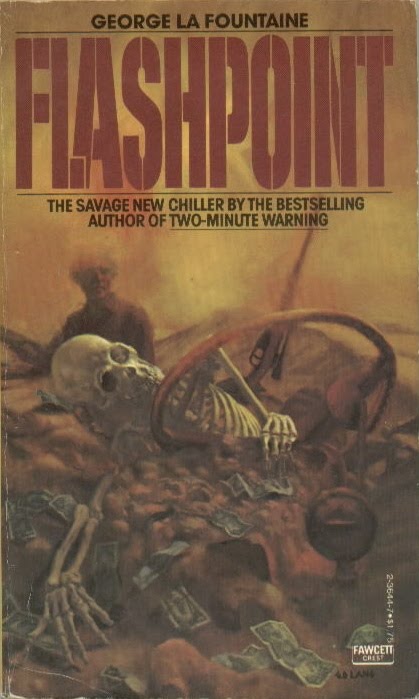 FlashPoint by George La Fountaine
Fawcett 2-3644-7
Copyright 1976
"But who in the hell can we trust to ask about it? We can't just walk into a bank and ask if this is counterfeit; they might be looking for numbers or something."
Ernie Wheeler and Bob Logan are best friends. They do everything together - eat, booze it up, lure the ladies to their bachelor pad-everything. They also work together, they are 1970s Border Patrol officers along the dry South Texas barren lands. Things are changing for them. The computer age is stepping in and they see the threat of their free-roaming job being replaced with one sitting behind a computer desk. They talk of chucking it all away and live high, but you need cash in the bank for that and they don't have any. Opportunity knocks one day when Logan discovers an old half buried jeep in a desert wash. Inside the jeep is a skeleton and $850,000 . The bills are dated back to the early 60s and since there is a rifle and other odd items in the jeep, Logan and Wheeler decide to secretly investigate into why it was there and who the bones belong to in the jeep. They later learn there is much more to this mystery than they ever thought. Deadly more....
Flashpoint is one of those fast paced thrillers that filled the book racks in the mid 70s. I had a hunger for them back then and this one slipped under my radar. I'm glad I caught up to the paperback. It contains all the ingredients for a violent, mysterious novel and as I was racing through it, I was always wondering on how it was going to end. It has a climatic finish which if you don't pay attention to the little clues that George La Fountaine provides throughout the novel, you might be very surprised. Logan and Wheeler are two well developed characters. They come off as semi-tough guys and show sympathy for the flight of the illegal immigrants. The only problem I had with them was they were a little too close of friends. A lot of interesting government intervention makes the mystery deepen. As the cover states, George La Fountaine wrote Two Minute Warning which was a huge success for him. For me, Flashpoint stands up right along side it.
Sunday, September 5, 2010
Kill Quick or Die by Stuart Jason
 Kill Quick or Die by Stuart Jason
(The Butcher #1)
Pinnacle Books 5th ed.
Copyright 1971
"Like I said before," Bucher told him. "With Syndicate scum it's either kill quick or die."
Thirty seven year old "Butcher" Bucher has moved up quick in the Syndicate. With his sharp wits, fast reflexes, and concrete willpower-Bucher was in charge of the whole East Coast Division. But now he is out and quitting doesn't sit too well with the Big Boys. The Syndicate puts an one hundred thousand dollar "death tag" on his head, but Bucher can handle anything they throw at him. Enter the U.S. Government who sees value in a man who possesses Bucher's intimate knowledge of Organized Crime. They offer him a job working as an agent for a covert group called "White Hat." Bucher accepts, he wants to atone for some of the things he did in his grisly past. But he has one condition, he gets to play it by his own rules. And his rules are: There are no rules, just violence and extreme street vengeance for anyone who gets in his way.
Kill Quick or Die is the first paperback in the Butcher series. And for me, these male testosterone adventure series are "hit or miss." I call this one a "hit." Keep in mind you can't take them too seriously and they have as much believability as those conspiracy wackos who still claim that the Apollo moon landings were staged. The story starts in Atlanta where Bucher is hunting down a Chinese scientist who is attempting to sell his secret plans for a deadly weapon. But this is just a minor event in the plot because what it really is about is having Bucher ruthlessly (no mercy is spared) eliminate members of the Mafia that cross his path. From Atlanta to Cairo the trail always ends with Bucher killing Syndicate hoods and hitmen. None are a match for "The Butcher." He stumbles upon a lucrative business the Mafia has that involves smuggling Arabs into the USA. With the price tag on his head and him nosing around in the Mideast, the Boys go all out to savagely annihilate Bucher. Leaving more dead behind, Bucher is off to Israel and back to Cairo after witnessing the horrifying results of the torture and crucifixion of his beautiful Arab girlfriend Tzsenya. The blood is really boiling now, as he flies back to Atlanta to seek and brutally destroy the head of this Mafioso operation.
Again Bucher stepped back to view his handiwork. This time he was more satisfied. The big Arab's face was warped out of shape by the broken jaw, his left ear was missing, his nose was a pulpy mess of split cartilage and chopped bone. Shreds of mangled flesh, recently his brows, hung down over his eyes and blood streamed from his face wherever the brass knucks had connected. Bucher decided only one thing more was needed. He stepped forward, crashed the knucks of his right fist into the blinded Ahmed's mouth. Teeth and splinters of teeth erupted from the mouth when Bucher jerked free his fist.
Like I said, you don't read these for a credible portrayal of an undercover agent or a man wanting to free himself of his past involvement with organized crime. This is about entertainment and fun. And Kill Quick or Die does deliver on those. The writing style is elementary and it's basically a step-by-step plot here. But the author made Bucher an irrefutable character and I was eagerly looking forward to what happens next in the story. Overall not bad for a paperback found in this for-men-only vengeance genre. As for the series, this is the only one that I've read and I have no idea what Butcher paperbacks are the best. But I might read another.
Oh, two things. Bucher has this silly inner "spider sense" that warns him when trouble is afoot. (Something that I wouldn't mind having) He also doesn't seem to have a first name. "The Butcher" is his Mafia handle, but his surname is used most throughout the novel-Bucher. (Like Cher, ahh but not really like her...)
Wednesday, August 4, 2010
Harry O by Lee Hays
 Harry O by Lee Hays
Popular Library 445-00269-125
Copyright 1975
She smelled musty. Just as her clothes were different, so was her scent. Before she had been scrubbed, a little girl; now she was a woman of the world.
This paperback is the first of two tie-in novels that Lee Hays wrote for the popular 70s Private Detective TV show. For two seasons from 1974-1976, David Janssen portrayed the pensioned ex-cop living on the beaches of the West Coast. The series has been hailed as one of the best P.I. shows ever on television. No argument here, it's always been my favorite (especially the second season episodes) and when I had a chance to pickup these tie-ins, I had to have them.
The novel starts similar to the TV episodes, with Harry's telephone ring and him mulling over if it is worth picking up. We get a brief bio of Harry Orwell in the beginning; the painful bullet in the back which resulted in his early retirement from San Diego PD, why he became a P.I., working on The Answer -his boat that will never taste water, taking the bus because his heap is in the shop, and of course his views around the existence of telephones. A woman named Mary Alice Kimberly believes her husband is out to kill her because she won't give him a divorce. The way she tells it there is a rich land deal going down in Mexico and if she is divorced the husband gets all the profits. For Harry she becomes difficult to keep tabs on and comes off as an enigma. Harry discovers that besides her husband, there are others out there looking for Mrs. Kimberly. And they may not be honest citizen types. The following day he finds Mary Alice in her husband's office with a dead P.I. on the floor. Even though Harry lightly has fallen for her, he quickly realizes she's a bit eccentric. When the dead P.I.'s stripper wife is found shot in the head inside Harry's beach home, the police bring Orwell in for questioning. They can't get nothing to stick, but warn Orwell to stay clear of the investigation. But he can't, even being odd the girl concerns Harry and now that she can't be located, he sets out to find out what this is all about.
It's about the smuggling of heroin across the Mexican border. Everyone involved is dirty. Included in the cast is a Sydney Greenstreet type befittingly named Sydney Jerome, who has mannerisms right out of The Maltese Falcon. There is a pint-sized gunsel called Wylie who drops Harry a couple of times. And a Mexican connection named Ramirez who seems to be playing both sides of the street. (or is being used by both sides) Orwell is on the hook for all of the murders, there are three total. Mary Alice finally calls him and together they head back to Tijuana to meet Sydney Jerome for a "business" transaction. It's on the return trip that Harry figures the deal out and then knows who is the cold-blooded killer.
Thinking of Ramirez reminded me that he warned me to take a gun. I didn't tell him that I never carry one. I almost went to the closet and got the one I had when I was on the force, the one wrapped in a towel way in back on the shelf behind an old suitcase. But I didn't, I should have but I didn't.
This "Harry O" paperback is far from being a great crime novel, but as a huge fan of the series I did enjoy it. I would say that the characterization of Harry Orwell in the story is fairly close to the TV one. The spoken narrative on the show is definitely much better. And the book didn't capture that lonely, somber persona that David Janssen was able to deliver. I'll chalk that up as something that is difficult for a tie-in author to do. The writing is straightforward and the plot though interesting, wasn't too difficult to figure out. Even with the similarities of Hammett's Casper Gutman, I would of liked to have seen more of the Sydney Jerome character. He came off as the most colorful of all in the story. All-in-all, it still was a fun quick read for me. If you were a fan of the TV series, I'm sure you would get a kick out of this novel also.
In addition, the series character Lt. Manny Quinlan appears in the novel. He doesn't head up the murder investigations for the SDPD, but he does have a role in the story.
 In 1976, Lee Hays wrote the second "Harry O" novel titled: The High Cost of Living. He wrote tie-ins for the TV shows Colombo and the Partridge Family. Lee Hays also authored the novelizations for the 1984 Sergio Leone film, Once Upon a Time in America and the 1974 horror movie, Black Christmas.
Wednesday, July 7, 2010
The Gargoyle Conspiracy by Marvin H. Albert
 The Gargoyle Conspiracy by Marvin H. Albert
Doubleday Hardcover,
Copyright 1975
It's no secret that I'm a huge fan of the novels written by Marvin H. Albert. His early Gold Medal publications covered Westerns, crime noir, and an excellent mystery series featuring the P.I. Jake Barrow. In the early 70's, he wrote four of my favorite adventure thrillers penned under the name of Ian MacAlister. Just after those came the "The Gargoyle Conspiracy," written right after Albert's move to France. It's an international thriller about a hunt for a dangerous Arab terrorist. Simon Hunter is an American cop that works for the State Department combating terrorism. This is 1975 and terrorists attacks in Europe are causing severe political tensions. Some want to appease the terrorists and others want to hit them hard. The ruthless Ahmed Bel Jahra is out to make a statement and his target is the Secretary of State of America.
The problem for Simon Hunter is he has nothing to go on. He doesn't know about Bel Jahra, ( the man is just a faceless shadow) he doesn't know who the target is, or where, when, and if the event will take place. Hell, he doesn't even know if any of this is actually real. But he shrewdly moves on it and slowly fragments come to light. The story goes from France to Morocco, Italy to the Arab world-told through the accounts of both men. We learn of the planning and recruiting of accomplices, when the story shifts to the charismatic Ahmed Bel Jahra. Then we are with Simon Hunter, tirelessly following any lead, to find what is going on and who is involved. This is superbly done.
"The Gargoyle Conspiracy" is longer (278 pages) than the usual Albert novels. There is a lot going on and many characters are involved. And because of the volume of characters, I really had to pay attention to what was happening in the story. But it was worth it. I've heard this novel being compared to Fredrick Forsyth's "The Day of the Jackal," and there are similarities. "The Gargoyle Conspiracy" is a little more violent and I found the major characters more intriguing. This received a well deserved Edgar nomination for Best Novel in 1976, and shouldn't be overlooked by readers of espionage thrillers.
Sunday, May 30, 2010
A Game for Heroes by James Graham (Jack Higgins)
 A Game for Heroes by James Graham
Doubleday HB ed., Copyright 1970
Nowadays, when I pick up a Harry Patterson novel, I feel like I'm going home again. Be it under the name of Patterson, Jack Higgins, Hugh Marlowe, or James Graham, the author continually delivers exciting plots with risk venturing characters. In my youth I've read so many of his early thrillers that reading one now I get a bittersweet longing for those days. The excellent "A Game for Heroes" is one of those and it's aptly titled because heroes and heroics fill the novel. But the tale really revolves around one and his name is Owen Morgan. And how can you not love this British Ops Specialist, with his scarred face, wearing a patch to cover his lost eye, the deadly tricks he does with his spring-loaded knife, and the numerous dangerous missions found in his dossier.
"So, now I was ready, the same man who had landed by night, had crouched here on this ledge a century ago. The same and yet not the same. I sniffed the cold air with a conscious pleasure and the same thought went through my mind as it had done before. A good morning-a fine morning to die in. If that was to be the end, then let it be so."
The story takes place during the last days of WWII. After recuperating from his last crippling mission, Colonel Morgan's next assignment is on his home island of St. Pierre in the English Channel. The Germans have occupied the island for five years and are determined to fight until the end regardless of the outcome of the war. Morgan's mission is check out the rumor of a secret sub base on the island that has been causing havoc to the Allies' shipping lanes. Also added to the mission is a commando raiding party lead by an upper-class American Major. This elite group will be planting bombs under ships in the harbor. Things go wrong and capture follows. And then the story turns into a chess play between just about everyone on the isle of St. Pierre, and with Owen Morgan smack in the middle of it all.
After five long years, the locals have a fairly casual relationship with the occupiers. In fact, Morgan old girl has fallen hard for a charismatic German officer who wears the Knight's Cross around his neck. Townsfolk are treated well (almost friendly) by the Germans, but the S.S. has a tight grip on the island. After the failure of Morgan's secret mission, there is the threat of death for all in the commando party. But like the title states, this is a hero story and there are plenty opportunities for Morgan and others. We find heroics during a monstrous sea storm, Locals and German soldiers taking sides against the S.S., pain and understanding within a love triangle, and in the end Morgan bravely facing off against the ruthless S.S. Kommandant.
I ate this one all up, but I do that with most of Higgins' early novels. I'm not a great fan of his recent Sean Dillon bestsellers. Don't get me wrong they are good, but for me nothing beats the early stuff. "A Game for Heroes" has a likable and self operating protagonist in Owen Morgan. A loner, a writer, a passionate man, who can switch into a hired bravo and cut-throat when the situation warrants. The novel is loaded with mesmerizing action sequences. The attempted sea rescue chapters may contain some of Higgins' best work and the novel is worth reading just for those pages. It's all tied into a crafty WWII plot that makes the reader feel like he is with Owen Morgan during his dangerous undertaking. I guess everyone who continues to read the works of Jack Higgins has their favorites, "A Game for Heroes" is definitely near the top of my list. I was thoroughly entertained.
Long live Harry Patterson. The man is a master of high adventure storytelling.
Saturday, May 8, 2010
The Freedom Trap by Desmond Bagley
 The Freedom Trap by Desmond Bagley
Fawcett M1789,
Copyright 1971
I have a handful of novels written by Desmond Bagley. Had them for years and never read one. Sometimes I see a captivating cover on a paperback and I end up laying my money on the counter when I'm checking out. And to be honest that's how I assembled a small collection of books from this British author of dangerous thrillers. I was digging through one of my boxes of paperbacks and "The Freedom Trap" caught my eye. (a no miss -with a frogman, exploding boat, and a red bikini) This convinced me to give Mr. Bagley a go and I'm glad I did. It was an unexpected high adventure ride that immediately turned me into a Desmond Bagley fan.
A small army of men rushed us and we were both grabbed and held. There wasn't a damn thing I could do- two of the three men who tackled me were trying to tear my arms off so they could use them as clubs to beat me over the head, and the other was using my stomach as a bass drum and his fists weren't padded as drumsticks are. I sagged and gasped for breath.
Joseph Aloysius Rearden (he rather would forget the Aloysius dub) is summoned from South Africa to perform a job. He's a better-than-average crook that has been in the "nick" before. In London he meets an esoteric man called Mackintosh and his efficient secretary Mrs. Smith. Together they lay out the plan to Rearden. They want him to knock over a postman who is delivering a package of uncut diamonds and immediately pass them over to Mackintosh before the crime becomes known. Rearden will be paid a tidy sum for what he believes will be a quick score. He accepts and it goes off smoothly. The postman takes a sap to the skull, Rearden snatches the package, and then he transfers it to Mackintosh. Well, in a matter of hours the local cops are at Rearden's hotel room and have enough evidence to drag him in. Sticking to his story that he is innocent, Rearden quickly realizes that its a lost cause. He's been setup and all fingers point to one person-Mackintosh. Rearden gets 20 years and becomes a "special" inmate because of the notoriety of the crime. And it is in the "gaol"while serving his time, that this novel takes a major 180 degree turn.
I don't want to reveal to much about this one. I will tell you that it contains a damn clever plot. The twist takes place at almost the half way point in the novel. To be honest, I was expecting something. I knew a little about Desmond Bagley and the type of novels that he wrote. But I expected it earlier in the story and he had me so absorbed in the crime aspect of the plot that he caught me off guard. I really liked that. Wonderful dialogue throughout the novel and I even got to pickup a few British slang terms that I never heard before. Rearden turns out to be an integrity character, as does Mackintosh and Mrs. Smith. Many people turn out to be more than what we are let on to believe, and that includes the minor characters in the story. Bagley seems to have a nack for this and he does it extremely well. A decent amount of action, especially near the end. But it's not overly done. Bagley places it where it is most effective. The strength of "The Freedom Trap" is in its excellent plot and its well-developed characters. If you enjoy the novels of Alistair MacLean and the early works of Jack Higgins, "The Freedom Trap" may be worth getting a hold of.
I discovered that John Huston's 1973 film "The Mackintoch Man" was based on this novel. It stars Paul Newman as Rearden and one of my favorite British actors, Harry Andrews as Mackintosh. It's one of the few Newman films that I have never seen. I'll have to get a hold of the DVD. From the characterization in the novel, I don't see Newman as Rearden. I'll have to see how that works out.
Sunday, March 7, 2010
Soldato! by Al Conroy
 Soldato! by Al Conroy
Magnum Book #75370
Copyright 1972
Al Conroy was just one name used by Marvin Albert during his brilliant writing career. I was quickly hooked on the author's work when I started reading his early Gold Medal books, especially the Private eye Jake Barrow novels written under the pseudo Nick Quarry. In the 70s, I was blown away by the four high adventure novels published by Fawcett that he wrote as Ian MacAlister. Around that same time he created the Soldato! series, which had it's run in a total of five books. (two of the later ones were written by the author Gil Brewer) I guess you would put them in the "vengeance against the Mob" category which was popular during that period. I held off reading the series because I never had a copy of the first book. Well, I finally got a hold of one and as expected, (Hey, it is written by Marvin Albert) this one is damn good.
Johnny did not intend to go back to just waiting for it to happen. Which left only one thing to do. Something that came to him naturally, out of his past. The answer was in his upbringing, his heritage, his blood.
There was a man who was trying to kill him. He had to get that man first. The law of fang and claw, city slum style.
Private eye Charlie Moran is an ex-cop and he specializes in finding people who don't want to be found. A year ago, Brooklyn Mafia boss Renzo Cappellani hired him to find Johnny Morini and now Moran is closing in. Loyal Johnny Morini worked his way up in the Mafia and was a high ranking soldato or soldier. After two members of Morini's adopted family were murdered, Morini turned rat and testified against Don Cappellani. The Federal witness protection program gave him a new identity and a new life in a small quiet Utah town. After spotting the stranger Moran, the little hairs on the back of Morini's neck start springing up. But it's too late, Moran makes the call and two professional hired killers arrive to payback Morini for what he did to Don Cappellani.
Along with his new wife, who knows nothing about his criminal past, Morini is chased into the high canyons of Utah. Outgunned, he is forced to take a stand. He knows the terrain and after an action-filled sequence of events, he eliminates the two killers. But he knows there will be no end to it, if they found him once they will find him again. With his wife in tow, he heads east to settle it back in NYC. And there is only one way he knows how to do it. He has to get the boss of the Brooklyn Mafia, Don Renzo Cappellani.
The first half of the book takes place in Utah and it's terrific. It starts immediately with the Private eye Moran finally finding his quarry in the placid town. No stopping for rest, the story explodes in the next enthralling chapters. These involve the chase in the canyons, as Morini is hunted by the killers who are armed with long distance hunting rifles. Not to take anything away from the rousing ending, but this was the best part of the novel for me. It was so good that I thought I was reading one of Marvin Albert's Ian MacAlister adventure thrillers. The second half takes place in the Big City where Morini knows the streets. We get the essence of his past criminal personality here, how he got started and what made him tick in those days. It's in this half of the novel that we discover the dark and solitary Johnny Morini. The story has a good dose of violence and bloodshed, and it is definitely clicking on all cylinders.
Besides the strong character of Johnny Morini, I really enjoyed Albert's depiction of the antagonist Renzo Cappellani and P.I. Moran. Though not in the novel as much as the other two, Moran is quite compelling and likable. He even shows up in the end, and it's like putting a stamp on the novel. As for Morini's wife and the others in the story, they are insignificant. Morini, Cappellani, and Moran make this one standout and it's good stuff all around.
After finishing this one, the well-written ending didn't leave me with the feeling that the exploits of Johnny Morini would be continuing. But of course, the publishers had plans and they spat out more. Here are the titles of the five in the series:
Soldato! 1972
Death Grip! 1972
Strangle Hold! 1973
Murder Mission! 1973
Blood Run! 1973
Tuesday, January 12, 2010
The Liquidator by R.L. Brent
 The Liquidator by R.L. Brent
Award Books AQ 1507
Copyright 1974
I've read a lot of decent 70s "Vengeance against the Mafia" series novels and I've read a lot of crappy ones. Having just finished the first in The Liquidator series, I have to say this was one of the better ones.
"I wanted to see the cop who was dumb enough to bust Monk Simon," she said in a low voice. "Don't you know he's more important than Kissinger?"
"That's the reason I busted him," Jake said.
Jake Brand is a rock hard Miami cop. Having seen his patrolman father killed by a crazed drug addict and his older brother blasted by a Mob hit, Jake bends the rules to take down the Organization. He makes plenty of enemies, which forces the Mob to put an end to Jake their top priority. They set him up to take the fall for a murder rap and Jake is sent to prison for five long years. When our boy gets out he's got one thing to live for... and he sets out to even the score.
Yes this story has been told before, but not written as well as this one. R. L. Brent (pseudo. for Larry Powell) shows his talent. The characters have solid personalities, the plot holds the reader and has none of the "goofiness" that I witnessed in other similar testosterone adventure novels, and I thoroughly enjoyed the action-packed plot. And best of all, Jake even comes off as a realistic character (well, sort of) and you can't help but like the rough guy.
I was pleasantly surprised by this one and I don't know if the others in this series are as good. But I will be reading another to find out. (Jake left a few strings hanging to prepare us for the second novel)
The Liquidator (1974)
Contract For a Killing (1974)
The Cocaine Connection (1974)
Invitation To a Strangling (1975)
Tuesday, December 30, 2008
The Four-Chambered Villain by Gary Madderom
 The Four-Chambered Villain by Gary Madderom
Curtis Books 07310, Copyright 1971
"The Four-Chambered Villain" is a chilling novel about a cold-blooded assassin. The sophisticated killer is called David Ekberg and he hires out his special talent throughout the international stage. In New York he is contacted by a representative from the Albanian UN delegation, who wants him to brutally eliminate four UN representatives. The Albanian plan is to force the UN to relocate to an African nation. And by showing that New York can't provide a safe haven for them, the UN Secretary General will easily agree to the move.
We follow Ekberg as he plans each assassination, the next one being more horrific than the last. Package bomb explosions, mutilations with a boning knife, and face to face strangulations that include splitting a man's skull open with a hammer -when Ekberg is hired to make these murders appear sick and vicious, he delivers. With the UN and NYC in a panic, his last target is the UN Secretary General and this one takes special planning.
This thriller moves fast and you're not disappointed in any of its 158 pages. In fact, this is one novel that you'll wish was longer, I didn't want it to end. The author amazing describes what makes Ekberg tick and shows that he is more than a glorified hitman. And as a reader you are almost pulling for Eckberg to successfully complete his hits, even if he is in the trade of killing innocent people. Also the eerie, cold, city atmosphere breathes a dark edge to the story. Quite an impressive little novel, that packs a hell of a punch.
Only minor flaw I had with "The Four-Chambered Villain" was near the end and that involved an operation in the hospital. But being that the novel was written in 1971, that scene may not have been that much of a stretch as I had thought. As for the author Gary Madderom, he wrote a couple of more novels, one that I know of is "The Jewels That Got Away." If I ever come across another novel by Madderom, I'll grab it.
"Ekberg calmly continued straggling her. A terrible retching sound somehow traveled up through her stocking-compressed neck and between her lips. Her body relaxed. She rode with death. Her sphincter let go and an instant later her bladder. Eckberg began to breathe through his mouth. He held on a couple of minutes longer and then let go"
Thursday, December 18, 2008
Havana Hit by Mike Barry
 Havana Hit by Mike Barry
#5 The Lone Wolf
Berkley Medallion, Copyright 1974
Barry N. Malzberg used the pseudo Mike Barry, for the fourteen Lone Wolf paperback novels he authored. Malzberg always seemed to find work. He wrote volumes of SF short stories that were published in magazines and anthologies. In fact, some are in book collections containing only Melzberg stories and these are very good. I recall three, “The Many Worlds of Barry Melzberg,” “The Best of Barry Metzberg,” and “Malzberg at Large,” as having some amazing SF stories. He also has a good number of novels in his bibliography. Besides SF, Malzberg dabbled in mysteries, adult sleaze paperbacks, and novelizations. In 1973, he started writing the Lone Wolf adventure series, introducing ex-NYPD cop Martin Wulff. From the four page introduction in “Havana Hit,” Wulff quits the force after his girl was killed by a deliberate overdose, and he becomes a one man wrecking crew that uses unrestrained violence to destroy drug kingpins and anyone that gets in his way. Alone, he built up quite a reputation, and now has the drug dealing organizations and the cops after him. Mean and obsessed, each adventure takes him to a new location where he leaves a large body count and extreme mayhem.
"Have you ever seen a seven-year old junkie? Have you ever seen a little girl holding a doll and so strung out on junk that she didn't know her name? Have you ever seen the soft men who peddle the stuff, the soft men in their houses on the bay, far away from all this, laughing at it, shielding themselves from what they've done, taking the money, filling the vein..."
It seems this story continues from where the previous one (#4) ended. Martin Wulff is flying out of Las Vegas on route to NYC with a valise full of heroin worth over a million dollars. Somehow this heroin was removed from the NYPD evidence room and got into the hands of organized drug traffickers. And during his last escapade in Vegas, Wulff went on a killing spree and blew up a hotel casino to get it back. The plane is hijacked and forced to land in Cuba. Taken into custody by a Cuba official named Delgado, Wulff’s valise is seized and he is sent to be executed. Delgado plans to keep the uncut heroin, sell it, and leave Cuba to live it up. But Wulff escapes and sets out to get the valise back. With a little help from a wimpy American helicopter pilot, he kills Delgado along with scores of other people and destroys the headquarters building. But the valise of heroin isn’t there. Delgado turned it over to DiStasio, who is the head of Cuban Intelligence. DiStasio has the same plan as Delgado had, take the heroin and get out of Cuba. Wulff hightails it to DiStasio’s estate and eliminates him to get the valise back. Then the wimpy American helicopter pilot gets enough courage to hold a gun on Wulff and attempt to steal the heroin himself. Of course Wulff outsmarts him and the American pilot ends up with a bullet in the spine and then one in the head. Martin Wulff races to the airport, hijacks a helicopter and off he goes, 90 miles north to the USA.
This one was painful. About a third of the way through, I said “it has to get better.” Halfway through, I realized it wasn’t going to get better. And once I finished it, I said “Thank God its over.” As an action novel, this one is lacking. The few scenes that have the explosions and gunplay are weakly described and there is no thrilling effect. The dialogue between characters tries to be hard, but comes off as tinny. And there are these constant-preaching rants by the character, mostly around how illegal drugs are destroying civilization. The only reason these rants seem to be in the novel is to fill it up to reach 192 pages. You get the impression that the whole idea around the Lone Wolf series was to quickly spit these novels out, and cash in on the popular 70’s genre of these numbered paperbacks featuring a violent crime crusader.
I got as much enjoyment reading this, as I would have listening to a Yoko Ono record album. This is the only Lone Wolf paperback I own, and I’ll probably not seek another. But I will not give up on Barry Malzberg’s SF stories. There are some good ones out there.
As for the scantily-clad maiden on the cover, no such female character is in the story. I hate when they do that.
Thursday, December 11, 2008
Sharky's Machine by William Diehl
 Sharky's Machine By William Diehl
Dell 18292, Copyright 1978
William Diehl waited until the resilient age of 50 to start his first novel. The story behind that, is he was a seated juror on a trial and was so bored with it, he grabbed a notepad and starting writing. Well if true, we have to thank his local jury commissioners office, because what came out was “Sharky’s Machine,” a novel that holds nothing back and throws just about everything at the reader.
She lay beside the table. Her face was gone. Part of her shoulder was blown away. The right side of her head had been destroyed. She was a soggy, limp bundle laying partly against the wall in front of the door, blood pumping from her head, her neck, her shoulder. A splash of blood on the wall dripped down to the body.
Sharky clenched his teeth, felt bile sour in his throat, cried out, "No. Goddamnmit, no!"
Kicked out of the narcotics department after a bloody shootout in the streets of Atlanta, Sharky gets thrown down into the lowly Vice Squad. But he’s a good hard street cop and along with fellow beaten down Vice misfits, (the “Machine”) they quickly stumble upon a high-class prostitution ring. The operation seems to be shaking down wealthy “johns,” so they set up surveillance involving everything from shadowing people to wire-taps. A hooker named Domino becomes the "person of interest" in the corrupt scheme and Sharky obsessively makes her the focus of the investigation. Just when we get comfortable with the violence, sex, and pace in the story, Diehl takes it to another level. You have an U.S. Senator making plans for a Presidential run linked to the call-girl, a shady millionaire called DeLaroza who is connected to the Senator and Domino, and one of the most ruthless paid killers I have come across in any novel. Murders start occurring and once Sharky learns that Domino’s life is in danger, the "Machine" decides to hush up the investigation from their superiors and go it alone.
This turns out bigger than a standard street cop novel. Millions of dollars of stolen gold from WWII is tied to DeLaroza, and he needs people silenced. The U.S. Senators’ bid for the White House is in jeopardy and he needs Delaroza’s help. And our crazed hitman just keeps on coming. Of course Sharky falls for Domino, and the sex scenes of her with customers and Sharky listening in on the wire, are vicariously erotic. (Definitely “adults only” stuff) The novel succeeds in capturing the acrid street pulse of the late 1970s, using violence on high-volume, plenty of foul mouth language, and mysterious characters thriving on sleaze and power. Diehl creates a dirty, rash, and cold atmosphere, which makes the private scenes between Sharky and Domino, that much more endearing. And it is these brief pockets of tenderness that balances out the extreme raw edge that dominates the novel. But don’t get me wrong, this novel was written to get your attention.
For starting late, William Diehl authored a handful of excellent novels and fans of his work will differ on which is their favorite. But for me, “Sharky’s Machine” will always be on top.
This novel is an erupting force that spits at you.....
Thursday, December 4, 2008
Purple Aces by Robert J. Hogan
 Purple Aces by Robert J. Hogan
Copyright 1933
Berkley X1746, May 1970
“G-8 and His Battle Aces” was an aviation pulp hero and from 1933 to 1944, he was featured in his own magazine. There were over 100 adventures that the WWI ace carried out, and his German enemies threw everything at him, in the air and on land. To keep his identity a secret, America’s flying spy was given the code name G-8. Along with his two wingmen, Nippy Weston and Bull Martin, many of the stories dove into the realm of science fiction, with evil German scientists working on the Kaiser’s orders to develop wicked ways to gain an edge during the Great War. In 1970, Berkley started reprinting these pulp adventures in paperback and I remember grabbing them off the drugstore rack.
In “Purple Aces,” captured American pilots are being converted into zombie-like flying warriors for the enemy. Induced by a chemical, it starts with them receiving a purple “ace of spades” birthmark on their forehead and quickly spreads the hideous color over the entire face. In turn, a demonic force controls the minds of the “reborn” pilots and they are programmed to execute suicide missions against American fliers. G-8 and his men are sent to uncover the source of this menace. Being an all-American hero, G-8 wastes no time engaging in dogfights and slipping behind enemy lines to get answers. Solving the mystery, which takes him through the halls of an ancient castle, G-8 meets again the mad Herr Doktor Krueger (a frequent enemy in many G-8 adventures) and a mind controlling genius scientist called Zwantag. Their final diabolical plan is in motion, time is running out, and both evil men must be stopped.
This is pulp at its best. It’s a highly adventurous tale, but what makes it stand out is that it is also a complete horror story. Hogan was a master of creating a mysterious lurking atmosphere, that takes the reader into lead-filled skies, dark dungeon enemy hideouts, and rat infested swamps. In fact the scenes in the swamp are some of the best I’ve read in any pulp story. Enhanced by mesmerizing dialogue and amazing air battles, “Purple Aces” is an adventure novel that can appeal to all ages. (Though like most of these stories, geared to the male reader) Whenever I read these pulp stories of yesteryear, I envision the early readers in the 30s and how in awe they must have been to be the first to escape in the adventure and the terror each story took them on.
Robert J. Hogan was an exceptional pulp writer and I forgot how much I enjoyed his tales until I recently revisited them. His pulp stories are full of mystery, adventure and horror; and if Berkley didn’t reissue them, I would probably never had discovered Hogan’s work. I believe eight “G-8 and His Battle Aces” novels were published in 1970/71, and the first three have covers by Jim Steranko.
1. The Bat Staffel
2. Purple Aces
3. Ace of the White Death
4. Bombs from the Murder Wolves
5. Vultures of the White Death
6. Flight from the Grave
7. Fangs of the Sky Leopard
8. The Mark of the Vultures
They are like a time capsule, from an era that seems to be fading away...
The exploits of “G-8 and His Battle Aces” are still being reissued. You can find them at Adventure House, along with Robert J. Hogan's other pulps, "Mysterious Wu Fang" and "The Secret 6."
Thursday, November 20, 2008
The Big Kiss-Off of 1944 by Andrew Bergman
 The Big Kiss-Off of 1944 by Andrew Bergman
Perennial Paperback P673, Copyright 1974
Having a tendency towards nostalgic things from the past, I’ve always enjoyed seeing detective stories where the author sends the reader back to a bygone era. In 1974, Andrew Bergman created P.I. Jack LeVine, and with him came a wonderful “time period” detective crime novel that took the reader back to the homefront days, when we were fighting two wars and the big-time politics were controlled by powerful conniving men using small-time hoods to do their dirty work for them.
"Every minute that I spent on this case I get sicker to my stomach. You walk in here, dump a pile of bills on my desk, and expect me to roll over and start wagging my tail. This isn't Washington, sweetheart. This is the big city."
New York gumshoe Jack LeVine (real name Jacob Levine) is described as a "38 year old, stocky, bald, Jewish bullfrog.” Not wanting to follow his father’s footsteps in the garment business, he opened a private eye office on Broadway and 51st street. Honest and respected, his business has been successful enough to pay the bills and keep his blue collar lifestyle going.
It starts off as a simple blackmail case. Chorus girl Kerry Lane hires LeVine to retrieve some stag films she starred in when she was struggling. Now being in a big Broadway show, the blackmailers are willing to exchange the films for cash to keep her name clean. The story accelerates quickly as LeVine finds one blackmailer murdered and starts getting pressure from influential people to drop the case. Kerry Lane’s father turns out to be an important banker in Philly, with political ties to the 1944 Republican Presidential candidate Thomas Dewey. Seeing a way to weaken Dewey in the polls, high level Democrats loyal to Roosevelt have the films and plan to use them to their advantage. Jack LeVine is loyal to neither party, only to himself, so he isn’t bought off easily. He has a code of ethics, and even with his life threatened many times, he remains on the case to get the negatives and prints for Kerry Lane.
You will get the feel of June 1944 America in this one. The story is rich in the atmosphere of the day; D-Day, diners, everyone smoking, radio shows, and snotty elevator operators-you’re definitely walking the streets of New York in the 40s. Andrew Bergman does a fine job mixing real life characters and events, into Jack LeVine’s world. I was surprised with the scheme of throwing a grunt private eye into Washington’s political shenanigans. In fact, as I was reading I was skeptical if Bergman could pull it off, but he did. The novel starts hardboiled and that fooled me a bit. I was expecting a knockoff Marlowe or Spade type of character. Not so, everyone who meets Levine likes him and he presents himself as an “average joe” just doing his job. Suspenseful ending, but I had the feeling that Bergman might have been pulling the reader’s leg a bit here. It all ends at Radio City with every “thug, mug, and free-lance muscle” in town preventing LeVine and Kerry Lane’s father from entering the building. They don costumes to get to the studio, which came off a little too silly for me. But a chase takes place and LeVine gets to pop off a few rounds from his revolver, all to make sure that his client gets what she originally hired him to do.
Andrew Bergman is a very successful screenwriter, film director, and novelist.
Sunday, November 16, 2008
Red Tide: A Chandler Novel by Jim Steranko
 Chandler by Jim Steranko
Red Tide: A Visual Novel
Fiction Illustrated, Vol. 3
Copyright 1976
Before they were called graphic novels, Jim Steranko created hardboiled P.I. Chandler in what was called a visual novel. Thinking it was a Philip Marlowe story, I purchase one in 1976, (the cover price was a buck, which was a lot to me at that time) What Steranko did was pay homage to Raymond Chandler and all the other classic private eye authors from that golden era. Being a nut for this stuff, I was blown away when this came out and remember reading the issue many times over.
"Something exploded at the back of my skull. Then the whirlpool opened at my feet. I dropped in.
I tried to stop the avalanche that roared toward me, then realized it was all in my head.
My head felt like I 'd stuck it in the barrel of a cannon during an artillery barrage..."
The title of the novel is "Red Tide" and the story contains the great images and text that are found in all classic P.I. yarns. A client walks in Chandler's office with a murder case. Chandler's jobs are mostly insurance frauds or cheating husbands, and he hesitates to take the case. But the money is green and off he goes. Chandler tackles broads, guns, and gangsters, taking a good amount of graphic punishment along the way. Full of shadows and suspense, it's over 30 years old and still provides pure hardboiled enjoyment.
The title rings a little like Raymond Chandler's short short "Red Wind," but don't be fooled -this is Steranko's creation. If I have to compare it to anything, I would say it has the resplendent noir atmoshere of Dick Powell's 1944 Marlowe film "Murder, My Sweet." Formatted in a 5x7 digest, this might be the first graphic novel ever published and may have started the genre in America. Billed in in the back as Steranko's "first movie-length visual novel, created in the tradition of Sam Spade and Philip Marlowe, a bare-knuckled mystery that will keep you guessing right up to the last page."
And I won't argue with that statement....
Note: Author Joe Gores provides a damn good, one page introduction to the story.
Monday, November 10, 2008
The Kremlin Plot by Don Smith
 The Kremlin Plot by Don Smith
Award AQ1402, Copyright 1971
He pressed the sharpened end of the wood under the fingernail and the excruciating pain made me jerk and the rope cut into my throat. He sat back and watched the drop of blood ooze out and run down the strip of wood and fall to the stone floor.
"The offer is still open," he said calmly.
One of the better written adventure series that came out in the 60s/70s heyday era were the "Secret Mission" espionage novels by Don Smith. The stories are actually mysteries and American Phil Sherman is our agent in the field. Sherman's cover is selling business equipment and this allows him to enter any country where the Agency feels the need to deploy his "special" talent. Don't be fooled into thinking he's one of those super vigilante CIA operatives, Sherman is a shrewd detective and the world stage is his turf.
In "The Kremlin Plot," the mission literally falls in Sherman's lap. On a business trip to Moscow, an attempted hijacking occurs on his plane. The hijacker is shot by the co-pilot, but before he dies he drops design plans for a new Russian missile defense system on Sherman. He enters Moscow knowing this is too hot to have on him and quickly heads over to the American Embassy to pass them off. A snag prevents an easy hand off, and before you know it people are coming out of the woodwork to find out what Sherman knows and what he has. Beautiful young female engineers, the KGB, British Intelligence, and nasty Chinese agents that are lurking in the shadows,-all play a deadly game to get the plans from Sherman.
Photographs of the plans are stolen from his hotel and Sherman sets out find who took them and get them back. Sherman has a backbone, but he has his limits. Through torture, bedroom bribes, and KGB interrogation, -he almost breaks, but stays on the trail and carries this mission to the end.
Lately, I've found myself reading more and more of these fine Don Smith novels. I missed them when they first came out, and I'm sort of glad because they are not dated at all. They are written so well that they come off fresh and new. I actually find the stories more believable than the bulk of the stuff that was coming off the printing machines during this era. The plots are well developed, with devious international characters as adversaries. (watch out for a duo of Slavic black marketeers) Phil Sherman comes off as the real deal. He doesn't carry a weapon or have any high tech gadgets. He's just a "dick" on a cloak and dagger case, that plays like a well crafted mystery crime novel. There are around twenty paperbacks in the series and I've enjoyed every one so far.
As for Don Smith, he is becoming one of my favorite authors.
Wednesday, September 24, 2008
Guns by Ed McBain
 Guns by Ed McBain
Random House, Copyright 1976
Someone reminded me that it's been over three years since Ed McBain passed away, I was all set to argue with him that "no he died last year," but I guess time does fly. "Guns" is a novel that I always was planning to read, but never did. I just finished it and McBain slams you in the face with this one.
"The side of Colley's face is throbbing where the shotgun stock collided with his cheekbone. The Smith & Wesson has been taken from his side pocket, he is aware at once of the absence of its bulk. He feels suddenly naked."
It's a 24 hour story of small-time robber Colley Donato. He and a couple of his pals rob a NYC liquor store and two cops are waiting. Colley blows the back of the head off of one of them and he's on the run from then on. As he is moving between apartments and meeting past acquaintances, we get an insight into Colley's mindset and how he became what he is. Brought up on the mean-streets of NYC, at twenty-nine he developed into an unstable, fearful (almost superstitiously) punk. The cops quickly get an ID on him and a massive city manhunt takes place. Colley allies himself with his partner's wife, but that goes sour. Escaping from NYC, he is left wandering in New Jersey with a constant hunger for a gun and trying to make another score.
This is a street-dirty novel and for 1976 it may have turn a few heads. But I'm sure Ed McBain had to present it that way to capture the vile nature of men like Colley Donato and the filthy streets they rise from. There are no decent guys (or girls) in the novel, just crooks, hookers, pushers, rapists and all of them cop-haters. The title has relevance throughout the novel and McBain latently reminds us of that. "Guns" is damn good, I read it in one setting and never looked at what page I was on. But beware, McBain's going to hit you with a fist.
Friday, September 19, 2008
The Last Detail by Darryl Ponicsan
 The Last Detail by Darryl Ponicsan
The Dial Press
Hardcover Ed., Copyright 1970
The transient barracks at Norfolk Naval Base are deserted at nine this morning, or almost deserted; Billy Bad-Ass, First Class Signalman, is asleep in the TV room at the far end of the barracks.
I'll never forget that opening line from Darryl Ponicsan's first novel. Set in the late 60s during dismal weather in late autumn, "The Last Detail" is a journey story. Although travel is involved, it not that type of journey. The novel is a bit forgotten, and that could be because of the fine Hal Ashby film. But good movies come from books that are usually better, and this is definitely the case here.
Billy "Bad-Ass" Buddusky is awaiting orders for a ship, when he pulls Shore Patrol duty with Richard "Mule" Mulhall. Both sailors are 32 year old "lifers" and their orders are to escort an 18 year old sailor to the Naval brig in Portsmouth, New Hampshire. Larry Meadows stole $40 from a polio donation box and was sentenced eight years hard labor. Billy and Mule look at this as a cushy detail, but as they head out with young Meadows, they discover differently.
It's a novel about understanding, pity, and duty. Billy and Mule realize that Meadows' sentence is too extreme, they feel sorry for him, and set out to show the young sailor a good time before he is locked up. It's a sailors good time they take him on, the only one they know. Giving him experiences that they feel the young man will miss out on, the two "brotherly" take Meadows on an accelerated tour of taverns, rowdiness, places of ill repute, and along the way form a drunken companionship. A friendship develops between the three, but it's a bleak friendship. We know that Billy and Mule will carry out their orders to the end, it's an understanding that all of them know as they continue northward, through Washington, New York and Boston. The closer they get to Portsmouth, the more they agonize within, because they allowed the bond between them to grow too strong. As Mule said, "I hate this chickenshit detail." As time is running out, the end of their journey draws near and the inevitable awaits them.
It's a sailor's novel; salty in language, humor and antics. I spent time in transient barracks, pulled Shore Patrol duty, and met "lifers" like Billy "Bad-Ass" Buddusky -there is reality here. Compassion develops and depressed sadness is left. Billy and Mule experience feelings of sympathy and affection for Meadows, as the unlikely friendship develops between the three sailors. And amazingly, Meadows comes to understand men like Billy and Mule. Away from the sea and naval bases, they find themselves in places always outside looking in. They live in a world where ordinary men must do undesirable duties. It's painful for all of them.
"Here we are," Billy says out loud, "three pals on a picnic. Do we think about other picnics? No, we ain't even been on one before. We never ice staked, we never seen the sights, all we know is whores and bars."
"We know ships," says Mule, "and we know our rate."
"Yeah, whores and bars and ships and our rates."
Hal Ashby's 1973 film which starred Jack Nicholson, followed the novel quite well, but it wasn't complete. The film omits the last two chapters and in those we learn the fates of Billy "Bad-Ass" and Mule, after they hand Meadows over to the Marines in Portsmouth. If you enjoyed the movie but never read the novel, you will want to....

