
 The Khufra Run by James Graham (Jack Higgins)
MacMillan Hardcover
Copyright 1972
Published in 1972, "The Khufra Run" is another adrenalin-filled adventure that was written under the author's pseudonym of James Graham. In his early writing days, Jack Higgins took the reader to different locations and in this one we start in Ibiza, Spain. Ex-'Nam pilot Jack Nelson runs a charter floatplane service there and he has been known to take a job or two on the illegal side when cash is low. Along with Harry Turk, an American ex-Marine that Nelson befriended when both were captured by the Viet Cong, they stumble on an opportunity to retrieve a loot of sunken treasure in the Khufra Marshes. But of course it won't be easy to accomplish. An abstruse nun, who Nelson saves from being raped, only knows the exact location of the treasure. A violent group is after her for the secret and her life is constantly in jeopardy. As the nun gains knowledge that Nelson and Turk have commando skills that can even the score against a formidable enemy, she allows both men to protect her and help recover the treasure for a share. As in most Higgins novels the action starts quick and never lets up. Nelson's plane is destroyed, there are more attempted attacks to stop them, and with a small cache of weapons the race is on to the Khufra Marshes.
Higgins is a master at narration. The trek that Nelson, Turk and the nun take to the marshes is an intense ride for the reader, all captured in a group of explosive chapters. Throw in an aging Hollywood starlet who may have a stake in the outcome, illegal drugs, bad weather in a hostile environment, explosions and constant dodging of automatic gunfire- and "The Khufra Run" becomes one of the best novels that I have read by Jack Higgins.
Jack Higgins wrote four novels under the name of James Graham. All take you on a deadly adventure that is packed with action between pages of a darn good plotted story:
A Game for Heroes (1970)
The Wrath of God (1971)
The Khufra Run (1972)
The Run to Morning (1974)
Saturday, July 16, 2011
The Khufra Run by James Graham (Jack Higgins)


Tuesday, July 5, 2011
The Man From Limbo by John D. MacDonald
 The Man From Limbo By John D. MacDonald
Short Story, Dime Detective Magazine
April 1953
Like many of the successful post-war American mystery novelists, John D. MacDonald got his start writing for the popular pulp magazines. There are some who believe here is where you'll find his best work, and I might agree with that statement. Try reading stories like "Finders Killers" or "In a Small Motel," and you'll find characters and plots with smothering situations that explode from the pages. "The Man From Limbo" appeared in the Apr. 1953 issue of Dime Detective. It may not be the best MacDonald short story, but it sure is a fascinating one. The story starts with shell-shocked ex-GI Dolph Regan, struggling within his inner darkness and fears, being constantly tormented by events from the war. He takes on a job as a traveling salesman, which lands him in a town where he finds his old platoon sergeant is running for mayor. Before we know it, Regan is on the run for a murder rap and his war buddy is out to kill him. All this has to do with the future control of corruption in the town and an amnesiac mystery from the past. Along the way he bumps into a couple of dames, one is out to help him and the other is there to harm him. MacDonald creates a hell of a setting and scraps it all together into a quick ending.
I do have favorite novels by John D. MacDonald, they are the non-Travis McGee novels. And it was through the pounding on that typewriter, writing for the pulps, that rooted those novels and made them extraordinary. "The Man From Limbo" can also be found in the 1992 crime anthology containing 23 Dime Detective Magazine stories titled, HARD-BOILED DETECTIVES.
Thursday, June 30, 2011
A Man Called Shenandoah
 A Man Called Shenandoah
TV Series 1965-1966
Talk about underrated TV Westerns from the 60s!
A Man Called Shenandoah starred Robert Horton as a shot up, near dead survivor found on the prairie. Once healed, he realizes he has amnesia and is destined to roam the Western frontier to discover his past and who he was. The doctor who helped mend him gave him the name Shenandoah. (which means "land of silence")
Due to stiff competition from the other networks, (and the fact that there was an abundance of Western action shows on TV at the time) A Man Called Shenandoah lasted only 34 episode. But the well written and original scripts with Horton getting in many tight spots make this series a lost treasure. A big bonus is the notable performance by Robert Horton throughout the short-lived series. I remember it as a haunting and extraordinary portrayal. The past big name Western shows get most of the recognition now, but it is these quality little gems that appealed to me way back then. A Man Called Shenandoah needs to be released on DVD. I only have a couple of episodes. I'm on the hunt to get them all.
Robert Horton had a fine voice and sang the title song for the series. He also cut a LP and if you have it, you're in luck.
Monday, June 27, 2011
The Cage by Talmage Powell
 The Cage by Talmage Powell
Avon G1346
Copyright 1969
Sykes touched his bleeding ribs. "That's good. Let him pay! Let the sun, the flies, and the buzzards have him, while me and you tear up a Mexican town with his five thousand dollars!"
Webb Cameron returns to his ranch after a tiring day of pole-setting and wire-stringing to find his wife brutally beaten, raped, and left mentally in a vegetable state. Showing no signs of improvement and unable to control his wife, Cameron builds a cage to keep her from harming herself. Vengeance is on his mind and the trail that is left by the culprits leads into the sun-scorched badlands. With no one to tend to his wife, Cameron locks her in the caged wagon and heads out after them. He believes that if she confronts those who ravished her, she will be will be cured and return back to normal. So his journey begins and along the way we meet a down-and-out prospector, an obscure couple what has a few skeletons in their closet, a band of half-starved renegade Indians, and the two mean bastards that Cameron is pursuing.
This is more than a revenge Western novel. There are some complex characters at play here and a shock or two awaits the reader during Cameron’s hunt for the abusers of his wife. Little subplots are in the novel. Lost honor and brutal survival are hopelessly demoralizing the not-so-merry band of Indians. The ranch couple goes along with Webb Cameron, not to help him, but mainly to restore a personal dignity that was lost. Whenever the story shifts to the villains, Sickly Sykes (who is white) and Columbus George, (who is black) it gets kicked up a notch. They are ruthless and savage boys lacking any sense of humanity, but they will arouse the attention of the reader. The main character Webb Cameron was the least appealing to me, but the others compensate plenty for him. Written in 1969, “The Cage” is a bit different from your traditional Western novel. I liked it – a good dusty story, merciless action, and an excellent ending. Not bad for a 127 page Western novel.
And written by the author that gave us those wonderful PI Ed River novels.
Saturday, June 11, 2011
The Looters by Albert Conroy
 The Looters by Albert Conroy
Crest s431
Copyright 1961
Colonel Targo studied her thoughtfully. Finally he shook his head. "You talk much too quickly, lovely one. I must make sure that you speak the truth. And there is only one way to be sure."
He went to the wall and took down a leather strap. There was a cruel lust in his face as he returned to her, and began...
Albert Conroy is one of many pseudonyms used by prolific author Marvin H. Albert. I’m a big fan of his novels and he never disappointed me. No matter if it’s a mystery, western, adventure, or detective story, in less than 200 pages he can package a thrilling narrative where the plot sails tirelessly and the lead character is truly magnetic. Written in 1961, it’s evident that the events in Cuba inspired the setting for Marvin Albert to craft “The Looters.”
Having his fill of prison and crime, retired safecracker Sam Morgan seems content scratching a living working on charter fishing boats in Florida. That all changes when he is offered a proposition by beautiful Colleen O’Hara. She needs him to open a safe on the Caribbean island of Caribo and is willing to pay highly for it. Well, Morgan refuses and ends up shanghaied to the island, where he learns more about the heist and accepts the offer. The corrupt dictator has his personal loot (millions of dollars in gold) stashed in a vault under the Fortress del Rey and two forces are willing to team up to get it. One is Colleen’s father -who happens to be an ex-gangster, and the other is Kosta -the leader of the underground rebellion. There’s plenty of action that takes place throughout the novel. The jungles are swarming with government men hunting down members of the revolution, which now includes affable Sam Morgan. Colleen and Morgan barely escape the pursuing soldiers, during which they witness the horrors of a ruthless dictator. Finally the time to act arrives and they siege the well protected Fortress del Rey. Kosta buys time holding off wave after wave of government soldiers as Morgan fights his way down into the vault and attempts to get at the loot.
Those familiar with Marvin Albert’s work may recognize some similarities in “The Looters” with the four high intrigue adventure novels he authored in the mid-70s under the pseudo Ian MacAlister. The story takes place in a volatile location, it features a likable protagonist who has in the past been known to dabble on the opposite side of what society deems is right, there is always an attractive girl involved, and the ending is filled with explosive combat. In fact, the take over of the fortress by Morgan and Kosta’s rebels, with them violently holding it in an Alamo-like manner, is a page turning thrill ride. I’m not going to say that “The Looters” is better than the outstanding Ian MacAlister books, but written 15 years before them, it doesn’t miss by much.
Saturday, June 4, 2011
Luke Malone - Manhunter
 In 1975, Atlas Comics - a little known comic book publishing company, released a three issue run featuring a rugged San Francisco private eye named Luke Malone. Luke Malone-Manhunter was the back story in the comic book series called Police Action featuring Lomax NYPD. Created and drawn by artist Mike Ploog, Malone is an ex-city detective who hits the bottle after his wife is killed in a botched bank robbery in which he was called on. Thrown off the force, Malone can be found crawling through dirty gin-joints and in the street gutters of Frisco. It is there where he mopes around with a “I don’t care” attitude. He is content being a violent rummy until a friend tells him that the mastermind of the bank robbery is still on the loose and convinces Malone to try his hand at being a P.I. Now he is on the prowl and hits the streets to settle the score. Tough-talk dialogue and fine artwork make Luke Malone-Manhunter a surprisingly good hard-boiled comic
 I have the first two of the 3 issue run of the series. The first one is called "Requiem for a Champ" (February 1975) and has Malone solving the murder of a skid-row bum who was once a lightweight boxer. The P.I. starts interfering in police business which takes him to an old burlesque queen, mob men, and on the receiving end of thumps on the head. The second issue is "Whatever Happened to Luke Malone?" (April 1975) and this is an origin story about how Malone came to be a P.I., which I briefly outlined above. These are quick scripted stories, containing plenty of creeps as bad guys and violent 1970s action that fulls up every frame.
If you like detective stories that are told and illustrated in comic books and graphic novels, you'll find Luke Malone-Manhunter to be up your alley. It is unfortunate that the comic book character had a short run, because the plots are tightly packaged and the Luke has a hard-edged vigilante soul inside him. When Luke Malone steps in to play ball, he turns it into a mean game.
Monday, May 30, 2011
The Boy Who Invented The Bubble Gun by Paul Gallico
 The Boy Who Invented The Bubble Gun
by Paul Gallico
Dell 0719
Copyright 1974
Nine and a half year-old Julian West is an innovated kid. He came up with his own little invention, a toy gun that shoots bubbles, and he is pretty excited about it. Shunned by his father, Julian sneaks out one night and with $150, he hops onto a Greyhound bus going to Washington to get a patent for his “bubble gun.” Well, the adventure begins and along the way we see it unfold through the eyes of the young boy.
The novel is subtitled An Odyssey of Innocence, and Paul Gallico beautifully captures that inevitable moment in life, when a young boy realizes that childhood is over and discovers what the world is really like. During Julian’s passage, he touches the lives of an odd assortment of characters. He meets up with two love-struck teenagers, a cat-and–mouse drama between the KGB and CIA, an immigrant musician looking forward to a new life in America, and there is even an unstable killer who attempts to hijack the bus. But its the bond between Julian and a disillusioned Vietnam veteran named Frank Marshall, that brings the reality of the existence of the unfair laws of human nature to him. Marshall takes to the kid, protecting and befriending him. Julian looks up to Marshall, who comes to symbolize many things in a world that can be both awe-inspiring and dangerous. And it is because of the trip and the time he spends with Marshall, that allows in the end, Julian’s relationship with his father to develop.
This is the second time that I read “The Boy Who Invented The Bubble Gun,” the first time was when it came out in 1974. The story of a nine year-old traveling alone across the country and some of the interactions between the characters, may be a bit unbelievable today. But I enjoyed it in 1974, and again in 2009. Paul Gallico was a remarkable writer. (If you ever read “The Snow Goose,” you'll know what I mean) It doesn’t matter that the novel was written 35 years ago, Gallico’s writing touches your heart and the maturing of Julian West will be long remembered.
“The Boy Who Invented The Bubble Gun” is a compelling story that takes us on a journey that is both heartwarming and inspiring.
Saturday, May 14, 2011
Flashpoint by George La Fountaine
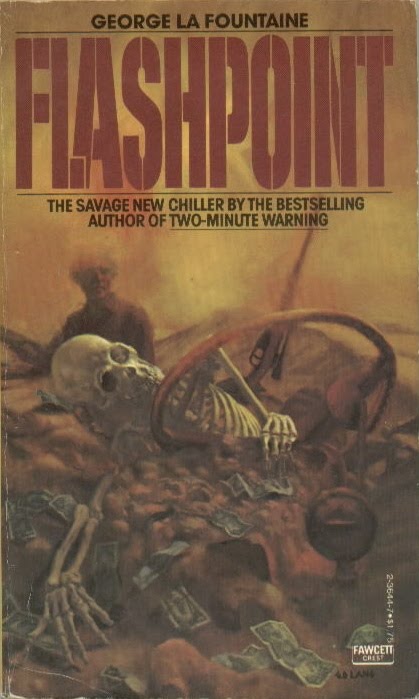 FlashPoint by George La Fountaine
Fawcett 2-3644-7
Copyright 1976
"But who in the hell can we trust to ask about it? We can't just walk into a bank and ask if this is counterfeit; they might be looking for numbers or something."
Ernie Wheeler and Bob Logan are best friends. They do everything together - eat, booze it up, lure the ladies to their bachelor pad-everything. They also work together, they are 1970s Border Patrol officers along the dry South Texas barren lands. Things are changing for them. The computer age is stepping in and they see the threat of their free-roaming job being replaced with one sitting behind a computer desk. They talk of chucking it all away and live high, but you need cash in the bank for that and they don't have any. Opportunity knocks one day when Logan discovers an old half buried jeep in a desert wash. Inside the jeep is a skeleton and $850,000 . The bills are dated back to the early 60s and since there is a rifle and other odd items in the jeep, Logan and Wheeler decide to secretly investigate into why it was there and who the bones belong to in the jeep. They later learn there is much more to this mystery than they ever thought. Deadly more....
Flashpoint is one of those fast paced thrillers that filled the book racks in the mid 70s. I had a hunger for them back then and this one slipped under my radar. I'm glad I caught up to the paperback. It contains all the ingredients for a violent, mysterious novel and as I was racing through it, I was always wondering on how it was going to end. It has a climatic finish which if you don't pay attention to the little clues that George La Fountaine provides throughout the novel, you might be very surprised. Logan and Wheeler are two well developed characters. They come off as semi-tough guys and show sympathy for the flight of the illegal immigrants. The only problem I had with them was they were a little too close of friends. A lot of interesting government intervention makes the mystery deepen. As the cover states, George La Fountaine wrote Two Minute Warning which was a huge success for him. For me, Flashpoint stands up right along side it.
Saturday, October 16, 2010
Eight Million Ways To Die by Lawrence Block
 Eight Million Ways To Die by Lawrence Block
Arbor House Publishing
Hardcover edition, Copyright 1982
My life was a ice floe that had broken up at sea, with different chucks floating off in different directions. Nothing was ever going to come together, in this case or out of it. Everything was senseless, pointless, and hopeless.
This is the fifth novel in the Matthew Scudder series and it's been hailed as the one that propelled the character and the series into wide notability. But if you read the previous novel, A Stab in the Dark, you could see it started there. In Eight Million Ways to Die, the "unlicensed" NYC PI does really breakout and Lawrence Block gives us one of the best detective mystery novels that was published in the 1980s.
As he sits in Jimmy Armstrong's, his favorite watering hole, ex-New York cop Matthew Scudder doesn't take every case that walks through the door. He picks and chooses, and it has to "feel right." The money feels right when call-girl Kim Dakkinen hires Scudder to talk to her pimp about freeing her from his stable. After finally locating the elusive pimp that goes by the street name Chance, Scudder finds that this case is easy money because Chance has no problem letting Kim go. For him, there are girls getting off the bus every day in NYC that he can hustle. But when Kim Dakkinen is found brutally slaughtered in a hotel room the next day, all fingers point to Chance. Though still a suspect, he has an air-tight alibi and with the police lose interest in solving a prostitute's death, Chance wants Scudder to investigate into her murder.
There is really two stories (or three) going on in Eight Million Ways to Die. One of course is the mystery surrounding why Kim Dakkinen was butchered and who did it. Block actually gives us all the clues, but we miss them because we are absorbed by the second storyline in the novel, and that is Matthew Scudder's battle with alcoholism. On the wagon and falling off it, the day to day punishment to stay sober bleeds through the pages towards the reader. It's remarkably well done. Down church basements to sit in the back at AA meetings and never participating, Scudder is really alone fighting off this demon that has plagued him. It's powerfully written and I found it more interesting than the fine whodunit plot in the novel. Another thing Block excelled on was creating a NYC where the streets are gray, dismal and violent. He throws this at us by having Scudder reading from the papers or talking with a befriended cop about the amount of relentless murders that are occurring in the City. And this bleak atmosphere goes directly in parallel with the inner conflicts tormenting Matthew Scudder's life. Scudder finds himself not immune to this violence also. There is an outstanding scene where he is pushed into a dark alley, mugged, and has to battle with his attacker. After all he is one of the eight million living in New York City.
All I wanted was an excuse to walk through the door of that bucket of blood and put my foot upon the brass rail. I closed my eyes and tried to picture the place, and in an instant I was recalling everything about it, the smells of the booze and stale beer and urine, that dank tavern smell that welcomes you home.
I wasn't sure is I was rooting for Matthew Scudder in this one or feeling sorry for him. I do know that when I first read this novel it played with my emotions. I never read anything like this in a PI novel before. The novel is filled with well developed secondary characters, the best being the pimp Chance and his small harem of prostitutes. Add Matthew Scudder and great storytelling, and Eight Million Ways to Die becomes a monumental PI novel. It is that.
If you are going to read just one Matthew Scudder novel, this is the one you want to read. But beware, I guarantee after this one you will want to read more.
Sunday, October 10, 2010
Mackenna's Gold by Will Henry
 Mackenna's Gold by Will Henry
Copyright 1963
For comforting an old Apache during his last dying hours, prospector Glen Mackenna is bestowed with the secret location of the Lost Canyon of Gold. Called Sno-ta-hay by the Apache, the canyon is a sacred place where mass amounts of gold are protected by ancient spirits. After memorizing the map even though he believes this is just a fable, Mackenna is then captured by the ugly renegade half-breed Pelon Lopez and his band of outlaw Indians. Pelon wants Mackenna to lead them to Sno-ta-hay and to persuade him to do so he holds a white girl hostage. Well, the adventure begins and along the way there are plenty of killings, a cavalry of Buffalo Soldiers hunting them down, forced alliances with nasty villains, and the truth about the legend of the Lost Adams Diggings at the Canyon of Gold.
What might lie ahead for his companions, he could not begin to imagine. What lay ahead for himself, he did not dare to think about. For the moment, only one thing was to be regarded as absolute certain: in such a company of human animals as that with whom he now loped through the desert night, death was no farther away than the nearest member of the pack.
Written by Will Henry (Henry Wilson Allen) in 1963, Mackenna’s Gold packs quite a bit of action in an evenly-paced Western novel. Though not a masterpiece, the plot that is spun around the quest for the gold is very good. In reality, there is a legend of the Lost Adams Diggings (a man named Adams boasted of finding the gold-filled canyon in 1864) and even today fanatics search for this legendary lost canyon. The Adams tale is the driving force in Mackenna’s Gold. And when you mix in the ragtag pursuit for the gold, Will Henry spins a decent Western story here. But I did have a few problems with the novel, most of them revolve around the characters. Mackenna comes off like a cream puff, he toughens up at the end but his image is cast early in the story. The hostage white girl is never really developed by Will Henry and only seems to be in the story as an excuse to force Mackenna to show the renegades the way. And Pelon is a total enigma. At times he is a vile, violent, ignorant killer and then later he acts almost Shakespearean as he rants to Mackenna about compassion and fate. It’s the pure-blood Native American characters in the story that captivate the reader. Pelon’s mother and sister, who are along on the quest, are the most intriguing of the group. Henry details their past and they play important roles in the outcome of the story. Another Indian called Hachita, who shows compassion towards Mackenna, extends to the reader a sense of the lost wonders of the American Indian way of life. Like a heart that has been touched by the sound of the water and the songbirds in the canyons, Hachita portrays a stature of honesty and morality when compared to all the other characters in the novel. I really liked the Hachita and Henry did a good job with the character.
Overall, I liked “Mackenna’s Gold.” Will Henry always has something going on in the story. The book has an underlying theme about the craze for gold and the consequences of tampering with sacred legend. And the history surrounding the Lost Adams Diggings is so damn interesting, it keeps the reader glued to the pages.
Not perfect, but it still is a good Western adventure.
Saturday, October 2, 2010
The Body Lovers by Mickey Spillane
 The Body Lovers by Mickey Spillane
Signet P3221
Copyright 1967
Spillane's The Body Lovers was written when Mike Hammer came out for round two. Round one being the six explosive Hammer novels from 1947-1952. In the 60s, the toughest fictional PI reappeared in five more novels. Some say they fall a step behind when compared to the first ones, but to me The Girl Hunters (1962) and The Twisted Thing (1966) didn't miss a beat. As for The Body Lovers, I will agree that it's not even near being one of top novels that feature Mike Hammer. But it still is a Mickey Spillane novel, and it still has the violently vindictive Mike Hammer reeling out his own ways of justice, and it still is entertaining as hell.
But it wasn't her he was seeing. It was me he was watching. I was one of his own kind. I couldn't be faked out and wasn't leashed by the proprieties of society. I could lash out and kill as fast as he could and of all the people in the room, I was the potential threat. I knew what he felt because I felt the same way myself.
Bang page one, Hammer stumbles upon a body of a beautiful girl that was whipped to death. From his cop buddy Capt. Pat Chambers, he finds out that other girls have been found tortured and killed. The only lead is that all were found wearing exotic negligee. Mike stays out of this one, even though most of the press and the public believes otherwise. But not for long, because a crook that Hammer sent to the slammer hears about the murders and hires Mike to locate his missing sister. The sister knew the dead girls and might be next. Quickly Hammer is setup for a hit, botched of course with him blasting the hood to kingdom come. The trail leads to the high fashion world and shady UN delegates. And when Velda, Hammer's full-time secretary and part-time associate, gets caught in the action and Mike discovers her missing, not only does he pulled back his snarly grin, the hammer on the .45 gets cocked and he is ready to release his rage.
A little less hard than you'll find in other Hammer novels. But when I comes, it comes. The best by far is when Hammer is looking for a pimp named Lorenzo Jones. He locates Roberta, one of Jones' whores. Roberta agrees to tell him where Jones is hiding but on one condition, Hammer must take her along to watch him kick the crap out the pimp. It's Spillane at his best. In The Body Lovers, Hammer comes off a bit older. He even realizes it. At one point he talks about dissection thinking and missed clues in this head, "Little voices, I thought. They were saying something, but were too far away to be heard. It wasn't like the old days any more. I could think faster then." But when he's ready to cut down the evil that has spread throughout the city, our revenge seeking white knight doesn't fail the reader.
This one has all that makes Mike Hammer novels a fun read. Including Hammer's (and Spillane's) views about commies, diplomatic immunity, bleeding-heart liberals creating loopholes in the justice system-they are all here. The reader is never disappointed. You can't go wrong picking up a Mickey Spillane novel. He was an American icon and created one of the most memorable private detectives in fiction.
Every now and then you have to get your Mike Hammer fix.
Friday, September 24, 2010
The Deep End by Owen Dudley
 The Deep End by Owen Dudley
ACE D-195
Copyright 1956
But you don't shoot cops. That's the end, if you do. The real deep end.
Pete Summer lost his memory from a plane crash over Mexican waters. As his memory returns, he decides to hide out in a quiet Mexican town for a year. And for good reason. Back home in California they believe he killed the man that he was flying to South America on a mineral deal. Everyone thinks Pete Summer is dead until a visitor arrives bringing back bad memories. He learns that his gorgeous wife is now married to an ex-gangster. Not only does Pete miss his wife, he is totally obsessed with her. So he decides to head back home to reclaim his wife. And that may not be such a great idea.
His face hardened. "Let's not kid ourself. You've got a beautiful pan hooked onto a terrific body. But there's nothing behind the face. You just do what I tell you and keep your mouth shut."
Owen Dudley is just one pseudonym that author Dudley Dean McGaughey used. He wrote plenty of novels and short stories, and Westerns fill the bulk of his work. But he did churn out crime mysteries and even some movie novelizations. (my favorite is End of the World for the 1962 Ray Milland film Panic in Year Zero!) He's a darn good storyteller and his early Gold Medal Westerns are some the best that they published. As for The Deep End, it's not the best Dudley Dean book that I've read, but it has a interesting little plot going on.
Pete Summers is a veteran of two wars,WWII and Korea, and that helped mold him into a tough hombre. But the odds are stacked against him from the start. Once word gets out that he is alive and in town, just about everyone is out to get him. Pete's brother-in-law has positioned himself to benefit having Pete presumed dead. Pete's arrival has jeopardize that. His wife's new husband has three thugs hanging around, ready to get their hands on Pete. And then he discovers that the man who bought his old ranch has been bedding his wife for years. After being left for dead in an old sewer hole, Pete really sets out to clear his name from the murder charge and even it up against those who wronged him.
It's a story that has been told before, it even includes that young girl character who had a crush on Pete growing up and is willing to help him through his quest. I liked the Mexican tie-in and having an ex-gangster as his wife's new husband. There a bit about the old guy having trouble satisfying his wife and resorting to hormone ejections. (No Viagra in the 1950s fellas!) It's a hardboiled read and it has plenty of action, but there are really no surprises in the end. But that doesn't make it one that should be written off. Even though the cops and others are gunning for Pete, it really isn't a "man on the run" novel. Pete seems free to roam about as he uncovers secrets and lies from the past, many involving his wife who was everything to him. The novel zips along at a fast clip, and it has to because these ACE paperback novels rarely get beyond 150 pages. Overall a fairly decent job. What is real good about this ACE Double paperback is the flip novel, The Quaking Widow by Robert Colby. Colby never got the fame and recognition that he deserved. Besides his outstanding Gold Medal paperbacks and his fine short stories, he had four novels published by ACE. I've read them all and The Quaking Widow is the best of the four.
Saturday, September 11, 2010
Day Never Came by Steve Fisher
 Day Never Came by Steve Fisher
Copyright 1938
Short Story in Ellery Queen's Mystery Magazine, Oct. 1953
Steve Fisher packs a lot in the pages of this short psychological thriller. Day Never Came is a bleak and dark story of a psychotic killer who gets a little too clever for his own good.
Set in prewar Shanghai as the Japanese are bombing the city, a isolated American Marine station waits for orders with a handful of jailed service members awaiting court-martial. Most involve petty stuff, but the Navy prisoner called Clark is in for espionage and as for moral principles, he has none. There is a witness out in the city and his only hope is to get to her before the trial. Clark plans and executes an escape which involves secretly murdering a guard. Dodging bombs he makes his way to the girl's apartment. The kicker is that the girl loves him, but that's a one way street for Clark and he ends up strangling her to keep her from testifying. Without being seen, Clark quitely sneaks back into the Marine brig and thinks he devised a solid alibi. Of course you can be a little too clever, and Clark surely is ... as we waits in his cell.
Readers of Steve Fisher's work know that he was a highly influential author in his day. Pulp, noir, and lives lost in the seedy underworld - his novels and stories are filled with a gritty, raw, (and yes, a romantic) edge on them. Day Never Came has all those. Unseen love, which Clark doesn't realize until it's too late. Madness, as he kills without remorse to save his neck. And pain, sadness, and a lost chance-as he sits in his locked cell at the end. For a short story it's very atmospheric and "the nasty's" what go around in Clark's head are oddly appealing. For me this short story came up as the best of the bunch in this fine 1953 edition of EQMM.
But that is not to say that the others weren't very good. Fredric Brown's 4 pager titled, Cry Silence is a masterfully written tale that questions, "was it murder or was it not." Which lines in parallel to the old question, "If a tree falls in the forest and no one is there to hear it, does it make a sound?" Another enjoyable yarn is the retired cop story Before The Act. Thomas Walsh wrote solid cop mystery novels (some involve rogue cops) and after reading The Night Watch and Nightmare in Manhattan, I realized I'd stumbled on lost treasures. I enjoy his storytelling and when I come across an anthology with a short story of his in it, I'll but it. And that was the reason I bought this EQMM years ago.
Here are the stories in this October 1953 edition:
High Court by Thomas Kyd
The Stroke Of Thirteen by Lillian de la Torre
Before The Act by Thomas Walsh
Laugh It Off by Charlotte Armstrong
Day Never Came by Steve Fisher
Cry Silence by Fredric Brown
A Wish For A Cigar by Will Scott
Ms. In The Safe by Frank Swinnerton
Night Of The Execution by Faith Baldwin
Helpless Victim by C.G. Lumbard
The World Series Murder by Rex Stout
Sunday, September 5, 2010
Kill Quick or Die by Stuart Jason
 Kill Quick or Die by Stuart Jason
(The Butcher #1)
Pinnacle Books 5th ed.
Copyright 1971
"Like I said before," Bucher told him. "With Syndicate scum it's either kill quick or die."
Thirty seven year old "Butcher" Bucher has moved up quick in the Syndicate. With his sharp wits, fast reflexes, and concrete willpower-Bucher was in charge of the whole East Coast Division. But now he is out and quitting doesn't sit too well with the Big Boys. The Syndicate puts an one hundred thousand dollar "death tag" on his head, but Bucher can handle anything they throw at him. Enter the U.S. Government who sees value in a man who possesses Bucher's intimate knowledge of Organized Crime. They offer him a job working as an agent for a covert group called "White Hat." Bucher accepts, he wants to atone for some of the things he did in his grisly past. But he has one condition, he gets to play it by his own rules. And his rules are: There are no rules, just violence and extreme street vengeance for anyone who gets in his way.
Kill Quick or Die is the first paperback in the Butcher series. And for me, these male testosterone adventure series are "hit or miss." I call this one a "hit." Keep in mind you can't take them too seriously and they have as much believability as those conspiracy wackos who still claim that the Apollo moon landings were staged. The story starts in Atlanta where Bucher is hunting down a Chinese scientist who is attempting to sell his secret plans for a deadly weapon. But this is just a minor event in the plot because what it really is about is having Bucher ruthlessly (no mercy is spared) eliminate members of the Mafia that cross his path. From Atlanta to Cairo the trail always ends with Bucher killing Syndicate hoods and hitmen. None are a match for "The Butcher." He stumbles upon a lucrative business the Mafia has that involves smuggling Arabs into the USA. With the price tag on his head and him nosing around in the Mideast, the Boys go all out to savagely annihilate Bucher. Leaving more dead behind, Bucher is off to Israel and back to Cairo after witnessing the horrifying results of the torture and crucifixion of his beautiful Arab girlfriend Tzsenya. The blood is really boiling now, as he flies back to Atlanta to seek and brutally destroy the head of this Mafioso operation.
Again Bucher stepped back to view his handiwork. This time he was more satisfied. The big Arab's face was warped out of shape by the broken jaw, his left ear was missing, his nose was a pulpy mess of split cartilage and chopped bone. Shreds of mangled flesh, recently his brows, hung down over his eyes and blood streamed from his face wherever the brass knucks had connected. Bucher decided only one thing more was needed. He stepped forward, crashed the knucks of his right fist into the blinded Ahmed's mouth. Teeth and splinters of teeth erupted from the mouth when Bucher jerked free his fist.
Like I said, you don't read these for a credible portrayal of an undercover agent or a man wanting to free himself of his past involvement with organized crime. This is about entertainment and fun. And Kill Quick or Die does deliver on those. The writing style is elementary and it's basically a step-by-step plot here. But the author made Bucher an irrefutable character and I was eagerly looking forward to what happens next in the story. Overall not bad for a paperback found in this for-men-only vengeance genre. As for the series, this is the only one that I've read and I have no idea what Butcher paperbacks are the best. But I might read another.
Oh, two things. Bucher has this silly inner "spider sense" that warns him when trouble is afoot. (Something that I wouldn't mind having) He also doesn't seem to have a first name. "The Butcher" is his Mafia handle, but his surname is used most throughout the novel-Bucher. (Like Cher, ahh but not really like her...)
Sunday, August 29, 2010
Too Many Girls by Don Tracy
 Too Many Girls by Don Tracy
Berkley G-182
Copyright 1934
I had a hell of a headache when I woke up.
So starts this brilliant piece of noir fiction about the exploits of an unprincipled Baltimore newspaper photographer. The actual title (hardcover) is Round Trip, which really sums up the road Eddie Magruder goes down. And maybe the point of the first sentence is to inform the reader that the journey of Eddie was one hell of a headache for him but it's a pleasure for us because this one is special.
I forgot all about everything. For a couple of minutes I was back before I'd met Edith and this girl was a good looking pushover and my hands were inside the neck of her dress and giving her the works.
The novel starts with Eddie being sent out on an assignment to snap some photos from the aftermath of a lynching done by Eastern Longshoremen. Here is where we get our introduction of Eddie -tough youth, on is own as a teen, learning the ways of women from the streets, and consuming plenty of booze. The novel then turns into a flashback as Eddie tells us about the events in his life during the last few years. There is the suicide of a female newspaper reporter that he had final contact with and he seems indifferent about. Eddie has the moral nature of a heel with just a snip of compassion. He is willing to earn a few extra bucks taking "dirty"photos for distributors or receiving special favors from women for taking high quality shots so they can get public notice. But that changes when he meets and marries Edith. Eddie finally finds felicity and worth in his life. But the road he is given to go down, isn't level. In a fistfight, Eddie kills Edith's abusive ex-husband and he has to stand trial for manslaughter. It becomes an emotional ordeal for both Edith and Eddie. But after the acquittal, all the despair ends and there is a return to a life of contentment. Of course, Fate stacks the cards against a guy like Eddie and in the end it really crashes down on him.
I thought to myself that if they sent me up, I still had a hell of a lot to be glad about. I was a bum when I met Edith and now I wasn't a bum. I was up for killing a guy but I'd done it the right way.
Block out the meaningless title the paperback publishers gave this one, Round Trip is a monolithic hardboiled novel. In Eddie Magruder's world, happiness only gets touched, never embraced. He doesn't self-destruct or have ambitions that lead him down a wanton alley, Eddie is stuck and will forever be because guys like him are always destined to be lured up and knocked down. It's just the way life is....
James M. Cain wasn't the only one reshaping raw and gritty noir tales in the 30s. Don Tracy was also right there, he just never got the notoriety that Cain did. A fine example is Round Trip, this tragic novel stands pretty tall with what others were bring to the table at that time. With the exception of Edith's Ex-husband, there are really no evil people in the novel. Most are disillusioned souls lumbering in depression-era Americana and working for a niche in life. With Eddie being swallowed up in all of it. This novel predates Horace McCoy's They Shoot Horses, Don't They? and Gresham's Nightmare Alley and Richard Hallas' You Play the Black and the Red Comes Up, and I'd put Round Trip right up there with them.
A memorable novel. I won't forget this one.
It's one of the best that I've read.
Saturday, August 21, 2010
The Long Night by Ovid Demaris
 The Long Night by Ovid Demaris
Avon T-372
Copyright 1959
Their Buick was at least five years old. These boys weren't doing so well. That's the first place the hood spends his loot. A big flashy car. Next on the list is the big sparkler on the little pinkie. These characters had neither.
He's an ex-Marine who went through hell on Tawara. Then for 9 years he was a LAPD Vice cop until he got kicked out after beating up a hood who he caught in his ex-wife's bed. The last 4 years he's been a P.I., who specializes in locating delinquent debtors and squeezing them to pay up. When it comes to women, he's a "legs and buttocks" man and he doesn't mind getting his "biological needs" from a $5 whore or a classy pickup in a bar. His name is Vince Slader and he's on a hard case, getting little sleep, that involves clearing himself from a murder rap.
The Long Night has a unique start. Slader is in front of a Senate Crime Committee hearing, sassing it up against two powerful senators. It seems that the private eyes in LA have been getting a bit out of control and Slader is the committee's poster boy. He leaves the hearings with warnings that they will be watching him and he better keep his nose clean. Like that's going to happen. Slader is hired by a scumbag casino owner to find a guy called Ben Russell. Russell has a $28,000 gambling debt and Slader gets a percentage if Russell pays up. Russell also has a young wife who has plans of her own, and those include a life insurance scam. Of course P.I. Vince Slader gets caught in it. He first gets setup to be murdered and burned to a crisp in Russell's car, the idea is that the authorities will believe he was Russell. Slader gets banged up pretty bad, but survives. Next he walks in on Ben Russell's actual murder and here is where he gets pegged as the murderer. Along with Mrs. Russell's motives to get her husband's life insurance money, elements of the local crime organization have an interest in this case. So besides the Senate Committee, Slader has thugs and cops after him now.
As for a plot, there is really no new ground breaking in this one. It's your typical P.I. being played for a patsy story. But that's OK, it still was an enjoyable read. The Senate Committee angle in the story was different and refreshing. Slader has an ex-con as an assistant called Emilio Caruso, who he kiddingly refers to as his "little wop." I liked the guy, unfortunately he doesn't make it through to the end of the novel. There is a good dose of explosive (and descriptive) gunplay in The Long Night. One of the best takes place in the desert outside of Las Vegas, with Slader having some fun with two hired killers. Slader plays the ladies throughout the story and even with his rough mug, they are attracted to him. He even gets serious with a redhead who helps him survive in the end.
Reading the The Long Night, I was wondering if Ovid Demaris was trying to make a Mickey Spillane type of novel here. It's close, but the narrative is less hardboiled and the ending fell a little flat. As for P.I. Vince Slader, I liked him. And with more appearances in novels and a little more development, he could of had a future. The Long Night is a good P.I. crime mystery, and it came darn close to being a very good one. As Maxwell Smart said, "Missed it by that much."
Here is a taste of some lines that Slader spouts about the fairer sex:
I turned and looked her over closely. Her looks were better than average for a barfly, but nothing to get worked up over. She was stacked, and dressed to prove it. I ignored the cleavage. There was nothing there I hadn't seen before.
She led me into the room, and the calves pumped and the buttocks shook. I didn't know where to look.
There are only two approaches to women - sweet and tough. And ninety percent of the time the tough will get you farther, quicker than sweet.
I have never felt much compunction about sex anyway. Women have been conveniently relegated to the role of machines for fornication. This is a hard-boiled attitude, and, like all such attitudes, it's microscopic and bigoted.
Saturday, August 14, 2010
Gator Kill by Bill Crider
 Gator Kill by Bill Crider
Walker Publishing
Copyright 1992
“You don’t look like much of anything,” he said, “except maybe an out-of-work housepainter.”
Well, that may not be true. Truman Smith does paint houses to earn a few extra bucks, but he will put to use his past experiences as a detective to perform investigations for a friend in need. In the 90s, Bill Crider wrote five novels featuring the Galveston-based PI Truman Smith. And I found him as one of the most realistic private eyes that came through the pages of mystery crime fiction in the decade of the 90s. Bill Crider portrays Truman Smith as a loner and a bit of an introvert, add this to the depth-lined cases he gets himself involved in, and the results are an outstanding PI series that snares the reader into some capricious surroundings throughout Southeast Texas. My favorite is the second "Tru" novel, Gator Kill. (though I recommend starting with the first, Dead on the Island) I read Gator Kill for the third time this week and I'm glad I did, because reading a Truman Smith mystery is like visiting an old friend.
There were actually two doorways, one leading to a kitchen and one into a bedroom. The bedroom was where I looked.
That's where the dead woman was. She was wearing a dress that seemed obviously homemade and about two sizes too big. It was some kind of blue material, but it was stained red in the front by blood. There was a small pool of blood beneath her. Most of it had soaked into the floor, staining it black. She looked fail and helpless in death.
Fred Benton is a tough old cuss and when someone kills and skins an alligator on his land, he’s going to do something about it. Coming off a missing person case that got his name in the news, part-time private investigator Truman Smith leaves Galveston Island to head over to Fred’s marsh property and have a look-see. Though not a glamorous case, to Fred killing the gator is murder and Tru agrees to investigate into who killed it. Of course there is more at work here than a rotting alligator. It first looks like Fred is being harassed and there are rumors that the State will be gobbling up surrounding lands. Then Tru steps into a double homicide and before you know it he becomes the target. Not only is he being shot at, but a tinted-windowed monster 4X4 is out hunting him down at night. But he understands this is the consequences of sticking your nose where people don’t want it. And it all comes to a head one night in a creepy, mosquito-infested swamp, when Fred and Tru drive out to investigate suspicious activities. An unexpected fatal meeting takes place and it's here where Tru puts the pieces of all the mysteries together. But it may be too late for him and Fred, as the eyes of the gators gaze upon them.
There’s enough plot twists in this one to keep the reader tightly gripping onto the book. Bill Crider has us going down one road and then he throws the curve. And later he does it again! The novel is filled with an assortment of colorful characters. My favorite is Fred Benton, who is sort of a sidekick in Gator Kill. A man in his 70s who is not afraid to provoke a fight, smokes unfiltered Camels, and has the stamina of a 40 year old. Heck, growing up I remember a guy just like that. There are characters throughout Gator Kill that we can relate to because we have run across types like them in our lifetime. The history behind Truman Smith is so damn intriguing, that we crave for more on him. A man that shuns people, he continues to be haunted by his inability to locate his missing sister. (there's more detail on this in Dead on the Island) When her murdered remains are found, he shoulders the blame and this adds to his unsocial-like state. All of this enhances the likable P.I.
This is the way I like my private detective novels. A whodunit that is packed with action, an ending that is just as much horror as it is mystery suspense, and an eerie atmosphere where the muggy nights are filled with rifle shots, mosquitoes, and mean gators lurking in the swamps.
Your shirt will be sticking to you when you read this one.
Sunday, August 8, 2010
Murder Doll by Milton K. Ozaki
 Murder Doll by Milton K. Ozaki
Berkley Diamond D2016
Copyright 1952
She fluttered mascaraed eyelashes and laid a hand on my arm. "Has anyone ever told you you're handsome?"
"Sure," I said, "my mother. What's your name, baby?"
Novels containing characters that deliver a hardboiled narrative have always been a favorite of mine. And Milton Ozaki's Chicago P.I. Carl Good definitely fits that bill. Good describes himself as having "features like a fistful of dough and carrying the beginning of a paunch." He then adds in his favor are height and broad shoulders. In WWII, Carl Good was a paratrooper who saw plenty of action and did his share of killing. He's an impetuous guy who likes Scotch and girls, and fancies himself as a rough, tough guy in a fight. He knows the town and has plenty of connections, which is a big benefit for a man in his line of work.
Right out of the gates, Carl Good is trying to locate the missing Orville Pederson. Hired by his wife, Pederson has been gone for a few weeks and left her without any spending cash. Good finds Pederson's plaything in a Chicago B-girl joint, but in a few minutes she is dead after taking a poisoned drink intended for Good. He learns that Pederson is connected to the Chicago mob and performs real estate deals for them. And through his many street contacts, Good finds out the the heat has been turn up and this is making things difficult for mob operations. It's causing friction in the ranks that is leaving an opportunity for a Philadelphia kingpin to elbow in. Pisano, the standing boss, offers Good $25,000 to find the identity of the person the Philadelphia boys have sent to orchestrate the takeover. All they know is that it is a woman and she's a looker. Carl Good isn't one to let a financial opportunity go to waste, he adds that job to his plate because this is "real money." Later he realizes that both cases are interconnected and as usual in these PI plots, Good is smack dab in the middle of both of them.
As I said, I'm a sucker for hardboiled narrative and Murder Doll has some of the best I've read in a while. Here are a few that I liked:
"She's just a hooker," I insisted flatly. "She hasn't got enough brains to file her toenails."
I went up the side of a pile of two-by-fours like a scared cat and flattened myself on the rough timber like juice on a platter.
She came to me and lifted herself onto my lap. One arm went around my neck and her mouth searched for mine. I felt like spitting after the kiss, but I didn't.
As for the storyline, the majority of the time you can tell what is going to happen. But there are a few surprises. One is when an enraged Good chokes a thug to death after failing to make the guy talk. Later Good finds out that the thug had his tongue cut out. This didn't seemed to bother the PI at all. There's also a remarkable scene when Good is being hunted down in a lumber yard. In his pocket he happens to have a grenade that he took off a bobby-trap that was setup for him. Removing the firing pin with his teeth and lobbing it at his pursuers makes a satisfying payback. A couple of things come off silly in the plot. One is having a woman organizing the takeover of the deep-rooted Chicago vice organization. The other is a wild scene at a Nudist park where Carl Good is strutting his stuff trying to get the lowdown on how the woman is luring men away from Pisano's organization. And if you can swallow these, you'll find a good crime mystery in your hands. Milton Ozaki has Carl Good operating in the streets of Chicago where the surroundings are dark and grimy. Good isn't your compassionate P.I. and he definitely isn't in the game to be morally upright. He does it for the money and it also is a good occupation for him to release an inborn fury onto the bad guys. I liked the guy and will dig out a few more of his paperbacks. Chicago's Carl Good is a hard-headed and conniving private detective, who should have gotten more literary recognition. This Berkley paperback edition was actually published in 1959. Murder Doll first appeared in the 1952 Phantom Books paperback authored under the name Robert O. Saber, a pseudonym used by Milton Ozaki.
Wednesday, August 4, 2010
Harry O by Lee Hays
 Harry O by Lee Hays
Popular Library 445-00269-125
Copyright 1975
She smelled musty. Just as her clothes were different, so was her scent. Before she had been scrubbed, a little girl; now she was a woman of the world.
This paperback is the first of two tie-in novels that Lee Hays wrote for the popular 70s Private Detective TV show. For two seasons from 1974-1976, David Janssen portrayed the pensioned ex-cop living on the beaches of the West Coast. The series has been hailed as one of the best P.I. shows ever on television. No argument here, it's always been my favorite (especially the second season episodes) and when I had a chance to pickup these tie-ins, I had to have them.
The novel starts similar to the TV episodes, with Harry's telephone ring and him mulling over if it is worth picking up. We get a brief bio of Harry Orwell in the beginning; the painful bullet in the back which resulted in his early retirement from San Diego PD, why he became a P.I., working on The Answer -his boat that will never taste water, taking the bus because his heap is in the shop, and of course his views around the existence of telephones. A woman named Mary Alice Kimberly believes her husband is out to kill her because she won't give him a divorce. The way she tells it there is a rich land deal going down in Mexico and if she is divorced the husband gets all the profits. For Harry she becomes difficult to keep tabs on and comes off as an enigma. Harry discovers that besides her husband, there are others out there looking for Mrs. Kimberly. And they may not be honest citizen types. The following day he finds Mary Alice in her husband's office with a dead P.I. on the floor. Even though Harry lightly has fallen for her, he quickly realizes she's a bit eccentric. When the dead P.I.'s stripper wife is found shot in the head inside Harry's beach home, the police bring Orwell in for questioning. They can't get nothing to stick, but warn Orwell to stay clear of the investigation. But he can't, even being odd the girl concerns Harry and now that she can't be located, he sets out to find out what this is all about.
It's about the smuggling of heroin across the Mexican border. Everyone involved is dirty. Included in the cast is a Sydney Greenstreet type befittingly named Sydney Jerome, who has mannerisms right out of The Maltese Falcon. There is a pint-sized gunsel called Wylie who drops Harry a couple of times. And a Mexican connection named Ramirez who seems to be playing both sides of the street. (or is being used by both sides) Orwell is on the hook for all of the murders, there are three total. Mary Alice finally calls him and together they head back to Tijuana to meet Sydney Jerome for a "business" transaction. It's on the return trip that Harry figures the deal out and then knows who is the cold-blooded killer.
Thinking of Ramirez reminded me that he warned me to take a gun. I didn't tell him that I never carry one. I almost went to the closet and got the one I had when I was on the force, the one wrapped in a towel way in back on the shelf behind an old suitcase. But I didn't, I should have but I didn't.
This "Harry O" paperback is far from being a great crime novel, but as a huge fan of the series I did enjoy it. I would say that the characterization of Harry Orwell in the story is fairly close to the TV one. The spoken narrative on the show is definitely much better. And the book didn't capture that lonely, somber persona that David Janssen was able to deliver. I'll chalk that up as something that is difficult for a tie-in author to do. The writing is straightforward and the plot though interesting, wasn't too difficult to figure out. Even with the similarities of Hammett's Casper Gutman, I would of liked to have seen more of the Sydney Jerome character. He came off as the most colorful of all in the story. All-in-all, it still was a fun quick read for me. If you were a fan of the TV series, I'm sure you would get a kick out of this novel also.
In addition, the series character Lt. Manny Quinlan appears in the novel. He doesn't head up the murder investigations for the SDPD, but he does have a role in the story.
 In 1976, Lee Hays wrote the second "Harry O" novel titled: The High Cost of Living. He wrote tie-ins for the TV shows Colombo and the Partridge Family. Lee Hays also authored the novelizations for the 1984 Sergio Leone film, Once Upon a Time in America and the 1974 horror movie, Black Christmas.
Saturday, July 31, 2010
Escape from Five Shadows by Elmore Leonard
 Escape from Five Shadows by Elmore Leonard
Dell #940, Copyright 1956
Most know that Elmore Leonard cut his teeth writing Western stories. For a young man that grew up in Detroit, he sure supplied the reader with a palpable portrayal of the Arizona Territory in the 1880s. "The Law at Randado" was my first Leonard Western novel. That was many years ago and at that time I thought I stumbled upon a Western that was different from the generic ones that I had been reading. The impact that "Randado" left on me made me seek out Leonard's other early Westerns. And I have read them all. One that is near the top on the list is "Escape from Five Shadows." It's filled with a wide variety of morally different characters stuck and struggling in a harsh piece of the dusty Arizona landscape.
Salvaje looked at his men. There were ten trackers here, and now he watched them remove their army-issue shirts and pants, stripping to breechclouts, then slipping on their cartridge bandoleers again. All of them wore curl-toed Apache moccasins folded and tied just below the knee: and to a man they carried single-shot Springfield carbines.
When they were ready, Salvaje nodded, and they moved off to take the escaped man.
Cory Bowen has been wronged, sent to prison for stealing cattle which he had no involvement in. He's been farmed out of Yuma prison, along with a handful of other prisoners, to work on territory road construction, which the Government has contracted to an iron-fisted independent named Frank Renda. The prisoners are housed in a makeshift convict camp called Five Shadows and Renda holds them there with a few guards, a ruthless gunhand, and a dozen Mimbre Apache police. Posted to watch over the Government's investment is the cowardly Willis Falvey, whom Renda has wrapped around his finger. Together they have been skimming off the money that the Government has allocated for the prisoners' care and the road work. It's become a profitable business for them, at the prisoners expense. Bowen escapes early in the novel and the Mimbre Apache trackers drag him back to Five Shadows. Renda gives him a beating and month's worth of brutal punishment. This is when the novel really takes a turns and we learn that through Bowen, others seek ways to form their own means of escape. And the others are not the prisoners. There is the wife of Falvey, who wants out of this stinking dead end part of Arizona. A girl that lives with her father at the nearby stage station, who is determined to get another trial for Bowen. And my favorite, the Mimbre leader named Salvaje, who is the most righteous and pure character in the whole story.
Not to give anything away, I'll just say that there is an opportunity for Bowen to plan another dangerous escape. Of course he takes it and this intertwines all characters, for some the results offer a weighed relief and for others there is contriteness. The risk for Bowen is great because a new trial is granted for him and he doesn't know it. Getting caught this time means death. "Escape from Five Shadows" isn't Elmore Leonard's best Western novel. (It's tough to compete with his later classics -"Valdez is Coming" and "Hombre") But it is still a well above average one and there is plenty to like in it. First is the remarkable picture of the old Arizona West that Leonard paints for the reader. The smells of horse, leather and dust get in your nostrils. Frank Renda and his gunhand are diabolical, and for some reason I find these characters compelling as hell. Elmore Leonard has Bowen being tormented by these two. He takes a lot of punishment, but remains determined to get out. (I guess that is the will of an innocent man) The best scene is without a doubt when the Mimbre Apache trackers are hunting down Bowen after his first escape. It happens early in the novel and it turns into a game of respect and bravery. A wonderful action snapshot episode in the novel.
I enjoyed this Elmore Leonard novel, but that's easy for me to say because he is one of my favorite Western writers. I have always wished he had written more Westerns. I prefer them over his crime fiction. I have hope that he will write another. It's been too long of a wait.

